
Automatic espresso grinders range from straightforward burr models to touchscreen machines and espresso makers with grinders built in. My best overall pick is the Breville Smart Grinder Pro for its dedicated grinder design and broad adjustment range; the Tuni G1 stands out for touch controls and 48 settings, while the Viesimple Gen 4 is a compact single-dose choice. The main tradeoffs are adjustment precision, convenience, retention and mess, plus whether you want a standalone grinder or a complete espresso machine. More settings and electronic controls can help with repeatable changes, but they do not guarantee better espresso by themselves. Read on for the full breakdown and guidance on matching a grinder to your routine.

Turn your wind-down time into listening time
- Thousands of audiobooks, podcasts and originals
- Listen on your phone, tablet or Echo — also offline
- Cancel anytime
Key Takeaways
- The Breville Smart Grinder Pro leads as a standalone pick because this roundup includes several simple grinders, but fewer options with a clearly espresso-oriented adjustment and control focus.
- The Tuni G1 and touchscreen 34-setting grinder emphasize control; their electronic interfaces may suit buyers who prefer timed, repeatable dosing over a basic manual workflow.
- The Viesimple Gen 4 takes a different route: single dosing and a magnetic dosing cup favor freshness and a compact counter footprint rather than a large bean hopper.
- Several models cluster around 48–51 settings, including options from AMZCHEF, KIDISLE, and SHARDOR, so interface, build, and dose workflow matter more than the setting count alone.
- The AMZCHEF and Gevi combine grinder and espresso machine, which can reduce appliance count but limits the choice to an integrated system rather than a standalone grinder paired with a separate machine.
| Viesimple Gen 4 Single Dose Burr Coffee Grinder |  | Best for Quiet Single-Dose Grinding | Burr type and size: 48 mm conical burrs | Burr design: Five-blade | Grinding style: Single dose | VIEW ON AMAZON | See Our Full Breakdown |
| Cuisinart Electric Burr Coffee Grinder DBM-8P1 |  | Best for Batch Brewing and Simple Controls | Grinder type: Electric flat burr | Grind settings: 18 | Bean hopper capacity: 8 oz | VIEW ON AMAZON | See Our Full Breakdown |
| Cusinice Conical Burr Coffee Grinder with 34 Grind Settings |  | Best for Beginner Espresso Dosing | Burr type: Conical | Burr size and material: 40 mm stainless steel | Grind settings: 34 | VIEW ON AMAZON | See Our Full Breakdown |
| Tuni G1 Conical Burr Coffee Grinder |  | Best for Broad Grind Adjustment | Burr type: Conical | Burr size: 40 mm | Grind settings: 48 | VIEW ON AMAZON | See Our Full Breakdown |
| AMZCHEF Burr Coffee Grinder UL-CG209-SV |  | Best for Large-Hopper Versatility | Model: UL-CG209-SV | Burr type and size: 40 mm stainless steel conical burrs | Grind settings: 48 | VIEW ON AMAZON | See Our Full Breakdown |
| Hauscafe Electric Burr Coffee Grinder with 38 Grind Settings |  | Best for Small Kitchens | Grind settings: 38 | Burr design: Conical | Operation: One-touch | VIEW ON AMAZON | See Our Full Breakdown |
| OXO Brew Conical Burr Electric Coffee Grinder | 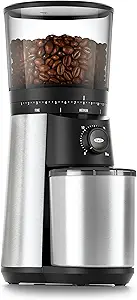 | Best for Simple, Higher-Capacity Grinding | Capacity: 12 ounces | Burr material: Stainless steel | Grind settings: 15 | VIEW ON AMAZON | See Our Full Breakdown |
| SHARDOR Electric Coffee Grinder with Visual Timing Knob |  | Best Multi-Use Blade Grinder | Capacity: 70g (2.5oz) | Operation noise: 63 dB | Grinding material: Stainless steel blades | VIEW ON AMAZON | See Our Full Breakdown |
| KIDISLE Conical Burr Coffee Grinder with 51 Settings |  | Best for Adjustable Timed Dosing | Grind settings: 51 | Timer: 1–60 seconds | Bean hopper capacity: 12.5 ounces | VIEW ON AMAZON | See Our Full Breakdown |
| Breville Smart Grinder Pro Conical Burr Coffee Grinder |  | Best for Precise Espresso Dosing | Model: BCG820BSS | Grind settings: 60 | Grind time adjustment: 0.2-second increments | VIEW ON AMAZON | See Our Full Breakdown |
| SHARDOR Electric Conical Burr Coffee Grinder with Touchscreen and 51 Grind Settings |  | Best for Portafilter Dosing | Burr material and size: Stainless steel, 40 mm | Grind settings: 51 | Timer: Up to 60 seconds, adjustable in 0.1-second increments | VIEW ON AMAZON | See Our Full Breakdown |
| SHARDOR Electric Burr Coffee Grinder with 16 Settings |  | Best for Multi-Cup Grinding | Grind settings: 16 | Capacity: 8.5 ounces | Cup selection: 2–14 cups | VIEW ON AMAZON | See Our Full Breakdown |
| AMZCHEF Espresso Machine with Grinder, Temperature Control, Milk Frother, Touch Screen, Cold Brew, Silver |  | Best All-in-One for Drink Variety | Grind settings: 44 | Temperature range: 190°F–201°F | Water tank capacity: 60 ounces | VIEW ON AMAZON | See Our Full Breakdown |
| Gevi Espresso Machine 20 Bar with Grinder, Professional Automatic Coffee Maker with 35 Grind Settings |  | Best Accessory-Rich Espresso Setup | Grind settings: 35 | Bar pressure: 20 bar | Material: Stainless steel | VIEW ON AMAZON | See Our Full Breakdown |
More Details on Our Top Picks
Viesimple Gen 4 Single Dose Burr Coffee Grinder
The Viesimple Gen 4 is the clearest fit here for espresso drinkers who weigh beans one dose at a time and want a tidier, quieter counter routine. Its 48 mm conical burrs, magnetic dosing cup, and sealed catch cup favor contained grinding rather than the larger hopper-and-cup workflow of the Tuni G1 or AMZCHEF. The claimed low-noise operation may also suit shared homes, while the compact format works for brewers switching among espresso, pour-over, and French press.
The tradeoff is that the supplied details do not give a hopper capacity, grind-setting count, or timer controls, so buyers seeking repeatable timed doses or clearly marked adjustment steps have less to go on than with the touchscreen models. Its single-dose, low-mess emphasis is the reason to choose it; skip it if batch grinding from a filled hopper is your priority.
Pros:- Magnetic dosing cup is designed to return to position, supporting a simple single-dose workflow.
- Sealed catch cup and blow-out funnel are intended to reduce stray grounds and cleanup.
- 48 mm conical burrs are specified for espresso and other brew methods.
- Aluminum construction and a stated two-year warranty provide useful durability details.
Cons:- No grind-setting count or timer details are provided, limiting comparison for precise repeat dosing.
- No hopper or grounds-container capacity is specified.
- Single-dose design is less convenient than the Tuni G1 or AMZCHEF for grinding larger amounts in succession.
Best for: Home espresso drinkers who weigh individual doses, share a kitchen or living space, and value a contained, quieter workflow.
Not ideal for: Buyers who want a specified range of grind steps, timed dosing, or a large hopper for grinding several servings without refilling.
- Burr type and size:48 mm conical burrs
- Burr design:Five-blade
- Grinding style:Single dose
- Dosing cup:Magnetic
- Noise level:Claimed under 50 dB
- Voltage:100–240 V
- Construction:Aluminum
- Warranty:Two years
Our verdict“Choose the Viesimple Gen 4 if quiet, contained single-dose grinding matters more than hopper capacity and clearly specified dosing controls.”
Cuisinart Electric Burr Coffee Grinder DBM-8P1
The Cuisinart DBM-8P1 takes a different approach from the espresso-focused Viesimple Gen 4: it is a hopper-fed grinder designed to produce grounds for several cups, with one-touch operation and automatic shutoff. Its 18 settings cover a broad range from fine to coarse, while the removable hopper and grind chamber make routine cleaning less awkward. For a household that makes drip coffee or French press in batches and only occasionally grinds fine, the straightforward controls may be more useful than the Tuni G1’s touchscreen and 48-step adjustment range.
That convenience comes with limits for espresso. The description does not specify espresso-focused dosing controls or a portafilter holder, and the 4-to-18-cup measure is based on approximately five-ounce cups, not a fixed dose. Compared with the Viesimple’s single-dose cup, this model prioritizes quantity and ease over a more tailored espresso workflow.
Pros:- One-touch controls and automatic shutoff simplify batch grinding.
- Removable bean hopper and grind chamber make cleaning more accessible.
- Eighteen settings span fine through extra-coarse brewing needs.
- Cup-based operation can grind for several servings in one cycle.
Cons:- Cup amounts are approximate and vary with brewing method, so they do not provide a precise espresso dose.
- No portafilter holder or electronic timer is specified.
- Its 18 settings offer fewer adjustment steps than the Tuni G1 and AMZCHEF.
Best for: Households that mainly brew multiple cups of drip coffee or French press and want a simple, hopper-fed grinder with removable parts.
Not ideal for: Espresso-focused home baristas who need precise dose timing, direct portafilter grinding, or more fine-grind adjustment steps.
- Grinder type:Electric flat burr
- Grind settings:18
- Bean hopper capacity:8 oz
- Ground coffee capacity:4–18 cups
- Approximate cup size:5 oz
- Controls:One-touch with automatic shutoff
- Warranty:Limited 18-month
- Included components:Scoop and cleaning brush
Our verdict“Pick the Cuisinart DBM-8P1 for uncomplicated batch brewing, but choose a more espresso-oriented model if dose precision is central.”
Cusinice Conical Burr Coffee Grinder with 34 Grind Settings
The Cusinice makes its strongest case through approachable dose control: a 0.1-second timer with smart memory lets a beginner adjust grind duration in small increments and recall the previous setting. Its touchscreen also offers timed or cup-based operation, and the portafilter holder keeps the grounds closer to the espresso workflow than the Cuisinart DBM-8P1’s batch-oriented setup. With 34 settings spanning espresso through French press, it can accommodate more than one brewing style without making the adjustment range as extensive as the Tuni G1’s 48 steps.
The compromise is a 40 mm conical burr, smaller than the Viesimple Gen 4’s 48 mm burrs, and fewer grind settings than the Tuni G1 or AMZCHEF. The supplied description also lacks a hopper capacity and warranty detail. I’d choose it for accessible controls and repeatable timing, not for the widest adjustment range or a documented high-volume setup.
Pros:- 0.1-second timer increments support fine adjustment of grind duration.
- Smart memory recalls the previous setting for a more repeatable routine.
- Portafilter holder supports direct espresso preparation.
- Thirty-four settings cover espresso and several non-espresso brew styles.
Cons:- Its 40 mm burrs are smaller than the Viesimple Gen 4’s 48 mm burrs.
- Offers fewer settings than the Tuni G1 and AMZCHEF.
- Hopper capacity and warranty are not specified in the supplied product details.
Best for: New home espresso makers who want a portafilter holder, a fine-grained timer, and controls that remember their last dose setting.
Not ideal for: Experienced espresso users who prioritize the broadest grind adjustment range, larger specified burrs, or documented hopper capacity.
- Burr type:Conical
- Burr size and material:40 mm stainless steel
- Grind settings:34
- Timer adjustment:0.1-second increments
- Dose memory:Recalls last setting
- Controls:Touchscreen with cup and time control
- Portafilter support:Portafilter holder
- Dimensions:7.16 × 5.19 × 14.25 in
Our verdict“Choose the Cusinice if you are learning espresso and value remembered, fine-increment timing over the widest grind range.”
Tuni G1 Conical Burr Coffee Grinder
The Tuni G1 earns its place for buyers who want plenty of adjustment steps without moving to a single-dose grinder. Its 48 grind settings and 40 mm conical burrs cover espresso through French press, while the electronic timer and included portafilter holder make it more espresso-ready than the batch-first Cuisinart DBM-8P1. A 250 g hopper supports a hopper-fed routine, and its 75 g grounds container can suit users who grind ahead or switch between brewing methods.
Compared with the AMZCHEF, the Tuni lists a slightly smaller grounds container and a smaller hopper, but its included dosing cup, dosing ring, and portafilter holder make the espresso accessories explicit. The touchscreen and many settings can take more getting used to than the Cuisinart’s one-touch controls. Choose it for range and accessories; skip it if you want the quietest, simplest single-dose setup, such as the Viesimple Gen 4.
Pros:- Forty-eight settings give more adjustment steps than the Cuisinart DBM-8P1.
- Electronic timer and included portafilter holder support espresso preparation.
- Dosing cup and dosing ring are included for a more equipped workflow.
- 250 g hopper and 75 g grounds container suit regular hopper-fed grinding.
Cons:- Digital controls may take longer to learn than the Cuisinart’s one-touch operation.
- The 250 g hopper may need refilling during larger-volume use.
- Its 40 mm burrs are smaller than the Viesimple Gen 4’s 48 mm burrs.
Best for: Home baristas who switch among espresso and other brew methods and want many grind steps plus included portafilter accessories.
Not ideal for: Buyers seeking the simplest controls, a single-dose workflow, or a hopper larger than 250 g.
- Burr type:Conical
- Burr size:40 mm
- Grind settings:48
- Motor speed:450 RPM
- Hopper capacity:250 g
- Grounds container capacity:75 g
- Dimensions:7.08 × 4.52 × 14.0 in
- Included accessories:Cleaning brush, dosing cup, dosing ring, portafilter holder
Our verdict“Choose the Tuni G1 if broad grind adjustment and included espresso accessories matter more than the simplest controls or a larger hopper.”
AMZCHEF Burr Coffee Grinder UL-CG209-SV
The AMZCHEF is the most capacity-forward of these hopper-fed options, pairing a 10.6-ounce removable hopper with 48 settings, touchscreen controls, and a timer adjustable in half-second increments. That makes it a practical choice for someone who wants to keep beans loaded and move between espresso, drip, and coarser brews. Its listed compatibility with 51–54 mm and 58 mm portafilters gives it a more direct espresso setup than the Cuisinart DBM-8P1, while the Viesimple Gen 4 is the better match for weighing each dose separately.
The tradeoff is that the timer’s half-second steps are less fine than the Cusinice’s 0.1-second control, and the cup options stop at 12. The 120 V specification also makes it a less flexible choice for international use than the Viesimple’s stated 100–240 V range. Pick it for hopper capacity and broad everyday use, not the finest timer control or a single-dose routine.
Pros:- 10.6-ounce removable hopper holds more beans than the Tuni G1’s 250 g hopper.
- Forty-eight settings cover espresso through coarser brewing methods.
- Touchscreen offers timed and cup-based grinding controls.
- Listed compatibility includes both 51–54 mm and 58 mm portafilters.
Cons:- Timer adjusts in 0.5-second increments, less finely than the Cusinice’s 0.1-second timer.
- Cup settings are limited to 2–12.
- Specified for 120 V power, unlike the Viesimple Gen 4’s stated 100–240 V range.
Best for: U.S.-based households that keep beans in a hopper, brew multiple styles, and want portafilter compatibility without weighing each dose separately.
Not ideal for: International buyers needing a wider voltage range, or espresso users who want very fine timer increments and single-dose operation.
- Model:UL-CG209-SV
- Burr type and size:40 mm stainless steel conical burrs
- Grind settings:48
- Hopper capacity:10.6 oz
- Timer:Up to 40 seconds, adjustable in 0.5-second increments
- Cup settings:2–12
- Power:150 W, 120 V
- Dimensions:7.4 × 5.1 × 13.4 in
- Portafilter compatibility:51–54 mm and 58 mm
Our verdict“Choose the AMZCHEF for a large hopper and flexible portafilter fit, but look elsewhere for single dosing or finer timer adjustment.”
Hauscafe Electric Burr Coffee Grinder with 38 Grind Settings
The Hauscafe is the compact, straightforward pick here for households that want one grinder for espresso and other brew styles without a crowded counter. Its 38 settings offer more adjustment than the OXO Brew’s 15, giving you more room to tune grind size as you move between brewing methods. One-touch operation and removable hopper and grounds container keep the daily routine simple, while the conical burr design is intended to limit heat during grinding. That flexibility has limits for espresso: the product information does not specify a timer or dosing controls, so repeatable espresso portions may take more manual attention than with the Breville Smart Grinder Pro. Its stated compact format and limited capacity also make it less suited to serving a busy household or commercial workflow.
Pros:- 38 grind settings span espresso through French press
- Conical burr design is intended to reduce heat during grinding
- One-touch operation keeps the routine simple
- Removable hopper and grounds container support easier cleaning
Cons:- No timer or programmable dosing control is listed
- Limited capacity is a drawback for grinding several large batches
- Not positioned for commercial use
Best for: Home brewers with limited counter space who want one-button grinding across espresso, drip, and French press.
Not ideal for: High-volume households or espresso drinkers who want programmable timed dosing and detailed control over each shot.
- Grind settings:38
- Burr design:Conical
- Operation:One-touch
- Hopper:Removable
- Grounds container:Removable
- Color:Black
Our verdict“Choose the Hauscafe if compact size and broad grind adjustment matter more than timed, repeatable espresso dosing.”
OXO Brew Conical Burr Electric Coffee Grinder
The OXO Brew prioritizes a roomy hopper and uncomplicated operation over fine-grained control. Its 12-ounce capacity suits people who keep beans loaded and grind for multiple cups, a more convenient setup than the SHARDOR blade grinder’s 70g chamber, which can require batch refills. Stainless steel conical burrs and 15 settings cover several brewing methods, but that smaller setting range gives espresso-focused buyers less adjustment than the Hauscafe’s 38 settings or Breville’s 60. One-touch starting and a static-fighting container aim to make routine use less messy. The tradeoff is a simpler control set: there is no digital timer or display listed, so I would favor this for low-fuss everyday grinding rather than precise, repeatable espresso dosing. Noise may also be a concern in quiet kitchens.
Pros:- 12-ounce removable hopper reduces frequent bean refills
- Stainless steel conical burrs provide a burr-based alternative to blade grinding
- Static-fighting grounds container is designed to reduce mess
- One-touch start makes routine grinding straightforward
Cons:- 15 settings offer less adjustment than the Hauscafe and Breville models
- No digital timer or display is listed
- Operation may be noisy
Best for: Coffee drinkers who grind for several cups at a time and want a removable, large-capacity hopper with simple controls.
Not ideal for: Espresso hobbyists who need a broad range of grind adjustments, a digital timer, or a display for repeatable dosing.
- Capacity:12 ounces
- Burr material:Stainless steel
- Grind settings:15
- Motor:DC motor
- Hopper:Removable
- Design:Sleek, compact
Our verdict“Pick the OXO Brew for convenient everyday batches, but look to the Breville or Hauscafe for more espresso-oriented grind control.”
SHARDOR Electric Coffee Grinder with Visual Timing Knob
The SHARDOR is the outlier in this espresso-grinder group: it uses stainless steel blades, not burrs. That makes it a flexible kitchen grinder for coffee, spices, herbs, and grains, but it is a different fit from the Hauscafe or Breville, whose burr designs provide adjustable grind settings suited to dialing in espresso. A visual timing knob gives you a direct way to control grinding duration, while the stated 63 dB operation may appeal to people trying to keep early-morning noise down. Its 70g capacity can cover a modest batch, though larger quantities mean stopping to refill. I’d choose it for mixed kitchen use and occasional coffee grinding, not for a buyer whose main goal is fine, repeatable espresso adjustment.
Pros:- Visual timing knob offers straightforward control over grinding duration
- Stated 63 dB operation may suit quiet kitchens
- Can grind coffee, spices, herbs, and grains
- Includes a coffee spoon with cleaning brush
Cons:- Blade design lacks the adjustable grind settings of the burr grinders in this roundup
- 70g capacity may require multiple batches for larger amounts
- Not the best fit for dialing in espresso grind size
Best for: People who want one compact electric grinder for occasional coffee plus spices, herbs, or grains.
Not ideal for: Espresso-focused buyers who need adjustable burr settings and repeatable fine-grind control.
- Capacity:70g (2.5oz)
- Operation noise:63 dB
- Grinding material:Stainless steel blades
- Control:Visual timing knob
- Included accessories:Coffee spoon with cleaning brush
- Warranty:2 years
Our verdict“Choose the SHARDOR for versatile small-batch kitchen grinding, not as a dedicated espresso burr grinder.”
KIDISLE Conical Burr Coffee Grinder with 51 Settings
The KIDISLE combines a wide adjustment range with a timer, making it a stronger fit for espresso routines than the OXO Brew, whose 15 settings and lack of a listed timer favor simpler everyday grinding. Its 51 settings provide room to tune across espresso and coarser methods, while the 1–60-second timer can help repeat a chosen grind duration once a workable dose is found. A 12.5-ounce hopper means beans can stay loaded between sessions, and the anti-static design is intended to reduce clumping and cleanup. Compared with the Breville Smart Grinder Pro, however, its listed controls are less finely specified: the Breville has 0.2-second timer increments and an LCD. The KIDISLE’s many settings may also take time for beginners to sort through, and no operating-noise figure is provided.
Pros:- 51 grind settings support adjustment across espresso and coarser brewing
- 1–60-second timer helps repeat a selected grind duration
- 12.5-ounce hopper holds a substantial supply of beans
- Anti-static design is intended to reduce clumping and cleanup
Cons:- Many settings may be less approachable for first-time grinder owners
- Timer increment precision is not specified, unlike the Breville’s 0.2-second adjustment
- No operating-noise level is listed
Best for: Home espresso drinkers who want a broad grind range, a timed routine, and a large bean hopper without relying on a blade grinder.
Not ideal for: Beginners seeking very simple controls or buyers who want a clearly specified fine-increment timer and display.
- Grind settings:51
- Timer:1–60 seconds
- Bean hopper capacity:12.5 ounces
- Burr size:40mm
- Material:Stainless steel
- Design feature:Anti-static
Our verdict“The KIDISLE suits espresso brewers who want many grind options and timed operation, provided they are comfortable dialing in the settings.”
Breville Smart Grinder Pro Conical Burr Coffee Grinder
The Breville is the most control-oriented burr grinder in this group, pairing 60 grind settings with a digital timer adjustable in 0.2-second increments. That lets espresso drinkers fine-tune grind time and direct grounds into a portafilter, rather than relying on the Hauscafe’s one-touch simplicity or the KIDISLE’s timer with unspecified increments. Its LCD shows the setting, time, and selected shots or cups, which makes adjustments easier to track from session to session. The tradeoff is a more involved setup than a basic grinder, and its 18-ounce hopper may still need frequent refilling for heavy use. At 15.33 inches tall, it also calls for more vertical counter clearance than a compact option. I’d favor it when dosing control matters more than a minimal footprint.
Pros:- 60 settings cover espresso-fine through French press-coarse grinding
- 0.2-second timer increments support precise grind-time adjustments
- Can grind directly into a portafilter, filter basket, or container
- LCD shows grind setting, time, and selected shots or cups
Cons:- Its controls are more involved than the Hauscafe’s one-touch operation
- 18-ounce hopper may need frequent refilling for heavy use
- 15.33-inch height may be awkward under low cabinets
Best for: Espresso drinkers who want fine timer adjustments, visible settings, and the option to grind directly into a portafilter.
Not ideal for: Buyers with limited vertical counter clearance or those who prefer one-button grinding without programmable controls.
- Model:BCG820BSS
- Grind settings:60
- Grind time adjustment:0.2-second increments
- Wattage:165 W
- Voltage:120 V
- Bean hopper capacity:18 oz
- Dimensions:6.28 × 8.46 × 15.33 in
- Item weight:6.4 lb
- Warranty:2-year limited
Our verdict“Choose the Breville if precise, visible dosing control and portafilter grinding outweigh a taller, more involved design.”
SHARDOR Electric Conical Burr Coffee Grinder with Touchscreen and 51 Grind Settings
The SHARDOR CG018B is the strongest fit here for espresso drinkers who want an electric grinder that doses straight into a portafilter. Its 51 settings cover espresso through French press, while the touchscreen timer adjusts in 0.1-second increments for finer control over grind time. Compared with the SHARDOR CG835B, this model offers a broader adjustment range and a portafilter cradle, but gives up the larger grounds capacity and cup-selection range. Anti-static features and included cleaning tools help manage the mess, though they do not remove the need for regular cleanup. The main compromise is its 1.4-ounce capacity: it suits drinks made one at a time better than repeated or larger batches. I’d choose it for espresso-focused convenience, not bulk grinding.
Pros:- 51 settings span espresso-fine through French press-coarse
- 0.1-second timer increments allow fine control over grinding time
- Portafilter cradle supports direct grinding into the basket
- Anti-static design and included cleaning tools help manage grounds and cleanup
Cons:- Small 1.4-ounce capacity is inconvenient for larger batches
- Espresso use may require adjustments to grind time and setting to suit the beans and dose
Best for: Home espresso drinkers who want timed grinding directly into a portafilter and rarely grind large batches
Not ideal for: Households making several cups at once, since the 1.4-ounce capacity calls for frequent refills
- Burr material and size:Stainless steel, 40 mm
- Grind settings:51
- Timer:Up to 60 seconds, adjustable in 0.1-second increments
- Capacity:1.4 ounces
- Cup selection:1–12 cups
- Dimensions:7.4 × 4.9 × 13.5 inches
- Weight:4.9 pounds
- Power:165 watts, 120 volts
Our verdict“Choose the CG018B if direct portafilter dosing and fine timer control matter more than hopper capacity.”
SHARDOR Electric Burr Coffee Grinder with 16 Settings
The SHARDOR CG835B prioritizes batch size and straightforward quantity selection over espresso-focused control. Its 8.5-ounce capacity and 2–14 cup timer range make it more convenient for grinding several servings than the CG018B, whose small chamber is better suited to single drinks. The tradeoff is a narrower set of 16 grind settings, so espresso drinkers have less room to tune the grind than they do with the CG018B’s 51 settings. Automatic shutoff, a safety interlock, and a removable grounds chamber keep routine operation simple, but this is a basic burr grinder rather than a dedicated portafilter-dosing setup. I’d pick it for households that value convenient batch grinding across brew styles; serious espresso users should favor a model with more adjustment range and direct basket support.
Pros:- 8.5-ounce capacity accommodates larger batches than the SHARDOR CG018B
- Selectable 2–14 cup quantity with automatic shutoff
- Removable grounds chamber makes transferring grounds and cleaning simpler
- Safety interlock helps prevent operation when parts are unsecured
Cons:- 16 settings provide less grind-adjustment flexibility than the CG018B’s 51
- No portafilter cradle or direct-to-portafilter dosing is listed
- Cup selection starts at two, limiting precise small-dose selection
Best for: Households that grind several servings at a time and want selectable batch sizes for different brew methods
Not ideal for: Espresso enthusiasts who need a wide range of fine adjustments or direct grinding into a portafilter
- Grind settings:16
- Capacity:8.5 ounces
- Cup selection:2–14 cups
- Power:150 watts, 120 volts
- Dimensions:7.48 × 5.16 × 9.76 inches
- Weight:2.6 pounds
- Material:Stainless steel
- Warranty:Two years
Our verdict“Choose the CG835B for larger, selectable batches, but pick the CG018B if espresso grind control is your priority.”
AMZCHEF Espresso Machine with Grinder, Temperature Control, Milk Frother, Touch Screen, Cold Brew, Silver
This AMZCHEF is not a standalone grinder; it combines grinding with espresso brewing and milk steaming. That makes it a better match for buyers who want one machine for several drink styles than the SHARDOR CG018B, which gives more attention to grinder controls and portafilter dosing. The built-in grinder has 44 settings, and the machine adds temperature adjustment from 190°F to 201°F, a steam wand, and a cold brew mode. Those controls offer room to tailor drinks, but they also create a busier learning curve than a separate grinder. Its 60-ounce tank can reduce refills during regular use, while the machine’s footprint may be harder to accommodate than a grinder alone. I’d shortlist it for a counter with room for an integrated setup; buyers focused primarily on grinding should choose a dedicated grinder instead.
Pros:- Built-in grinder provides 44 settings for adjusting grind size
- Temperature range of 190°F–201°F adds control over brewing
- Steam wand supports milk-based drinks
- 60-ounce water tank and cold brew mode support varied drink routines
Cons:- More involved operation than a standalone grinder such as the SHARDOR CG018B
- All-in-one machine may take more counter space than a dedicated grinder
- Grinder controls cannot be separated from the espresso machine
Best for: Home coffee drinkers who want an integrated grinder, espresso maker, temperature controls, milk frothing, and cold brew mode
Not ideal for: Buyers seeking a compact standalone grinder or a simple setup with few controls
- Grind settings:44
- Temperature range:190°F–201°F
- Water tank capacity:60 ounces
- Power:1350 watts
- Steam wand:Stainless steel, 8 mm
- Controls:Touchscreen
- Additional mode:Cold brew
Our verdict“Choose this AMZCHEF if you want one machine for grinding, espresso, steamed milk, and cold brew rather than a grinder alone.”
Gevi Espresso Machine 20 Bar with Grinder, Professional Automatic Coffee Maker with 35 Grind Settings
The Gevi pairs a built-in burr grinder with an espresso machine and a broad set of included accessories, making it a more complete starting point for home espresso than either standalone SHARDOR grinder. Its 35 grind settings give buyers some room to adjust beans for espresso, though the AMZCHEF all-in-one offers 44 settings and adds temperature control plus cold brew mode. Gevi’s case is practical rather than control-heavy: the machine includes a portafilter, filters, tamper, milk pitcher, cleaning brush, and espresso glasses, so fewer separate pieces are needed to get started. The steam wand supports milk drinks, but the available details do not specify a temperature range or water-tank capacity. Buyers new to espresso may also need time to learn the combined machine, and the grinder may be noisy.
Pros:- Built-in burr grinder has 35 adjustable settings
- Steam wand supports cappuccinos and other milk drinks
- Included portafilter, filters, tamper, pitcher, brush, and glasses provide a useful starter set
- Stainless-steel construction
Cons:- Combined machine may take practice for espresso beginners
- Grinder noise may be disruptive in a quiet kitchen
- Fewer grind settings than the AMZCHEF machine’s 44, with no listed temperature range
Best for: Home espresso beginners who want a grinder-machine combination with key brewing and milk-frothing accessories included
Not ideal for: Buyers who prefer a standalone grinder, quieter grinding, or specified temperature and water-capacity controls
- Grind settings:35
- Bar pressure:20 bar
- Material:Stainless steel
- Grinder:Built-in burr grinder
- Steam wand:Included
- Included accessories:Portafilter, filters, tamper, milk frothing pitcher, cleaning brush, espresso glasses
Our verdict“Choose the Gevi for an accessory-rich espresso machine and grinder bundle, but favor the AMZCHEF if temperature control and more grind settings matter more.”

How We Picked
I compared these products as home espresso grinding options, prioritizing whether their design and controls appear suited to espresso adjustment, along with dosing workflow, usable grind range, cleaning, footprint, and the amount of information provided about their features. A high setting count is useful only if changes are manageable and repeatable; I treated timers, portafilter holders, and touch controls as workflow benefits, not proof of grind quality. I also separated burr grinders from blade-style or broadly marketed multi-purpose grinders, since espresso demands finer, consistent adjustment than many other brew methods.
The order favors standalone grinders with the clearest espresso-focused controls and useful day-to-day workflow, then weighs simplicity, capacity, and versatility. Products with limited grind-setting information or a broad coffee-and-spice purpose rank lower for espresso precision. The AMZCHEF and Gevi machines are included for readers who want an integrated setup, but they sit apart from standalone grinders because their convenience comes with less freedom to mix and match equipment. Where specifications alone cannot establish grind consistency or retention, I avoid treating them as settled performance facts.
Factors to Consider When Choosing Automatic Espresso Grinders
Before choosing a model, decide what role the grinder must play in your coffee setup. The right choice depends not just on settings, but also on how often you change beans, whether you weigh each dose, and how much control you want over the espresso machine itself.
Match the adjustment range to your espresso routine
Espresso often needs small grind changes as beans age, humidity shifts, or you change the dose. A larger number of settings can offer finer steps, but the number alone does not reveal how useful those steps are at espresso-fine levels. Check whether the manufacturer describes the grinder as suitable for espresso and whether the controls allow repeatable adjustments. If you also brew French press or drip coffee, a wide range may be handy, though switching between methods can mean recalibrating your preferred setting. Avoid buying on setting count alone; the usability of the adjustment mechanism matters just as much.
Choose between hopper dosing and single dosing
A hopper suits households that use the same beans frequently and want to grind without weighing every serving. Single dosing is a better fit if you rotate beans, buy in small quantities, or want to weigh each dose before grinding. The tradeoff is convenience: a hopper can speed up repeated drinks, while single dosing adds a step but keeps bean choice flexible. Think about how many coffees you make at once and whether more than one person uses the grinder. Also check how the grounds are delivered; a portafilter holder or dosing cup can make the routine cleaner, but cannot compensate for a workflow that does not fit your machine.
Treat timers as workflow tools, not dose guarantees
Timed grinding makes it easier to repeat a routine, particularly when you prepare the same drink each morning. It does not guarantee an exact dose, since grind size, bean density, and the amount of coffee in the hopper can affect how much comes out in a set time. If shot consistency matters, weigh the grounds and use the timer as a starting point rather than a substitute for a scale. Touchscreens and preset controls can make adjustments easier to remember, but simple controls may be quicker when you rarely change settings. Choose the interface you will actually use, rather than paying attention to how advanced it looks.
Plan for cleaning, retention, and counter space
Fine coffee grounds can cling inside a grinder or remain in its chute, affecting freshness and making changes between beans less tidy. Look for clear cleaning instructions and consider whether the hopper, burr area, and grounds path are accessible. A compact grinder can free counter space, but a smaller footprint may also mean less capacity or a more involved dosing routine. Before buying, measure the available height as well as width, especially if the grinder will sit under cabinets. If you switch beans often, prioritize easy access for cleaning over a large hopper that will stay full of one blend.
Decide whether an integrated espresso machine is worth the compromise
An espresso machine with a built-in grinder can simplify setup and keep the grinder and brewer together. That convenience also ties your grinding and brewing choices to one appliance, so a later grinder upgrade may require replacing or working around the whole machine. A standalone grinder gives you more freedom to pair it with a different espresso machine and replace one component at a time. Consider integrated models when counter space and a unified workflow matter more than modular upgrades. Before choosing one, confirm that its grinder controls suit your espresso needs rather than assuming an included grinder is equivalent to a dedicated unit.
Frequently Asked Questions
Can a grinder with 50 settings make better espresso than one with fewer settings?
Not by setting count alone. More steps may make it easier to adjust shot flow in small increments, but burr design, adjustment calibration, and consistency also shape the result. A well-calibrated grinder with fewer settings can be easier to use than one with many steps that are hard to distinguish. For this lineup, compare the control style and espresso focus alongside the count. If possible, prioritize a clear adjustment system and a workable return policy over the largest number printed on the box.
Should I buy a standalone grinder or an espresso machine with a built-in grinder?
Choose a standalone grinder if you want to pair equipment freely, replace parts separately, or upgrade your grinding without changing your espresso machine. An integrated model makes sense when a single appliance and a coordinated workflow matter more than modularity. The tradeoff is that grinder performance and machine features are bundled together, so you should evaluate both before buying. Think about counter space, repair options, and whether you already own a machine. The AMZCHEF and Gevi in this roundup belong to the integrated category, not the same upgrade path as the standalone grinders.
Is single dosing a better choice if I switch beans often?
It can be, since single dosing lets you weigh only the beans you plan to grind and makes it easier to change coffees between sessions. It does not remove the need to clear old grounds from the grinder, so cleaning and retention still matter. A hopper may be more convenient if you use one coffee every day and make several drinks in a row. Consider how much effort you are willing to add to each dose, not just how fresh the beans stay. The Viesimple Gen 4 is the clearest single-dose fit in this roundup.
Do I need a portafilter holder or touchscreen for home espresso?
Neither feature is required to make espresso, but each can make a particular workflow easier. A portafilter holder keeps the cup positioned during grinding, which is useful if you want hands-free dosing directly into the basket. A touchscreen may make timers and settings easy to read, though it does not improve grind quality on its own. If you prefer weighing doses into a separate cup, a holder may matter less. Choose based on how you prepare coffee and how simple you want daily adjustments to be.
Can I use a spice grinder or a basic burr grinder for espresso?
A grinder marketed for spices, herbs, or general-purpose use may not offer the fine, repeatable adjustment that espresso typically needs. A basic burr grinder can work for some setups, but check its espresso range rather than assuming every burr model is suitable. Espresso machines can be sensitive to small grind changes, so an unsuitable grinder may make it difficult to control shot flow. If espresso is your main brew method, favor a model with explicit espresso-focused controls. A multi-purpose option makes more sense when espresso is occasional and other uses matter just as much.
Conclusion
For most buyers seeking a standalone automatic espresso grinder, I would start with the Breville Smart Grinder Pro as the best overall option in this lineup. The Viesimple Gen 4 is my best fit for compact, single-dose brewing, while the Tuni G1 is a strong choice for buyers who want electronic timing and touchscreen controls. For a value-minded purchase, compare the simpler burr models such as the Cuisinart DBM-8P1 or the 38-setting grinder, but check that their adjustment range suits your espresso machine before deciding. Beginners who want a guided, all-in-one setup can look at the AMZCHEF or Gevi machines, accepting less flexibility than a separate grinder and brewer. If you want the most control over future upgrades, choose a standalone grinder; if you want fewer appliances and a unified setup, an integrated machine may be the better match.