TL;DR

Turn your wind-down time into listening time
- Thousands of audiobooks, podcasts and originals
- Listen on your phone, tablet or Echo — also offline
- Cancel anytime
Fit&Well reports that Tai Chi teacher Brian Thompson recommends a five-minute sequence of breathing, gentle movement and self-massage for winding down before bed. Thompson says it may ease tension and settle breathing, but the source does not provide research showing that this routine improves sleep.
Fit&Well has published a five-minute evening Tai Chi routine from instructor Brian Thompson, who says gentle movement and breathing can help people unwind before bed. The sequence includes seated breathing, standing arm movements, weight shifts and a brief self-massage; the report does not establish that it treats insomnia or guarantees better sleep.
The routine begins with one to two minutes of seated breathing. Sit upright on a sturdy chair with both feet flat on the floor, relax the shoulders and chest, and follow the natural breath through the nose. The instruction is to let the breath rise and fall without forcing it.
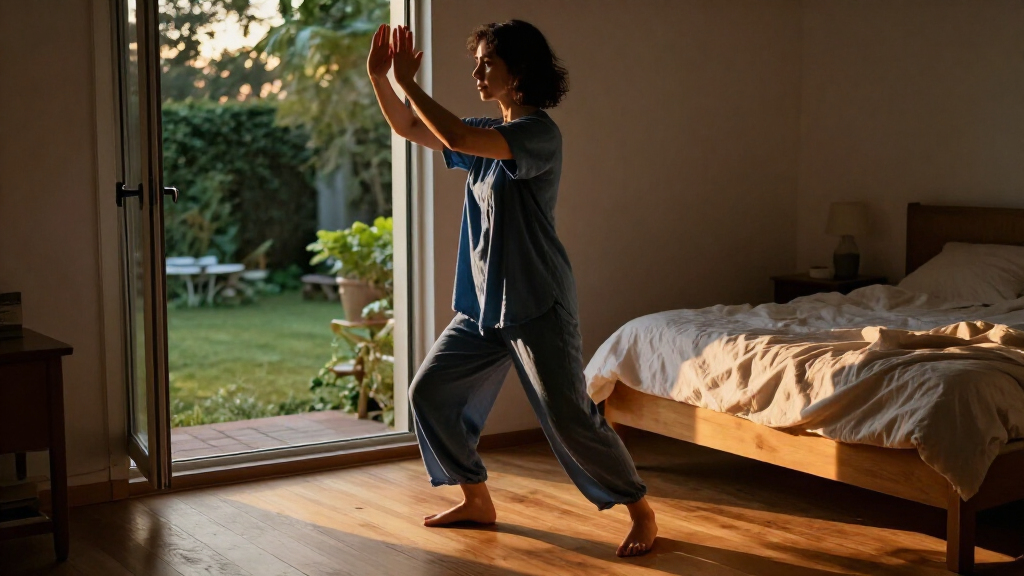
Next, stand with feet about shoulder-width apart and knees slightly bent. For the “lift water” movement, raise relaxed arms to shoulder height while inhaling, then lower them gently. The routine calls for two or three repetitions. Thompson’s longer silk-reeling section adds slow arm circles and shifts of body weight from one leg to the other, coordinated with breathing.
It ends with gentle massage and cupped-hand patting over areas such as the shoulders, arms, torso and legs, performed standing or sitting beside the bed. Fit&Well presents these movements as a short sequence for closing out the day; the instructions do not prescribe a medical treatment or specify that each movement must be performed at a particular pace beyond doing it slowly and comfortably.
A Short Routine, Not a Sleep Cure
The routine is a practical option for readers who want a brief, low-impact wind-down activity rather than a more strenuous workout late in the day. Its emphasis on gentle movement, attention to breathing and releasing bodily tension may make it feel calming for some people. Thompson links those elements to settling the body before bed, but that explanation is his account of the practice, not proof that the five-minute sequence improves sleep for everyone.
That distinction matters for anyone dealing with ongoing sleep problems. The article offers a set of movements, not evidence from a clinical trial, a comparison with other approaches or a promise of a particular outcome. Readers can treat it as a relaxation practice if it feels comfortable, while avoiding the assumption that it replaces professional help for persistent sleep difficulties.
As an affiliate, we earn on qualifying purchases.
How the Five Minutes Are Structured
Tai Chi is described in the Fit&Well report as an ancient Chinese practice involving gentle movement and breathing, with an emphasis on the mind-body connection. The report notes that it can be practiced at different times of day, while Thompson’s suggested sequence is specifically framed for the evening.
The routine moves from stillness to motion and then touch: seated breathing, arm lifting, silk-reeling movements with weight shifts, and a closing massage. That progression is the central practical detail in the report. It gives readers an outline they can follow, but the source does not identify a formal study of this exact five-minute routine or compare it with other bedtime practices.
“The benefit of an evening Tai Chi practice is that it helps to unwind accumulated physical tension in the back, neck and shoulders from the day.”
— Brian Thompson, Tai Chi teacher and founder of BNEW4LIFE, as quoted by Fit&Well
Sleep Effects Remain Unverified
The report does not cite a study testing this exact sequence, quantify any sleep outcomes or state how often someone should practice it to see a benefit. It is also unclear whether the routine changes sleep onset, sleep duration or sleep quality, or whether any effect varies by person. The article’s description of possible relaxation benefits should not be read as confirmation that Tai Chi will resolve sleeplessness.
The source does not give detailed adaptations for people with mobility limitations or explain how to modify movements that cause discomfort. Anyone who finds a movement painful or unsteady can stop rather than push through it. Persistent sleep problems or health concerns are matters to discuss with a qualified health professional.
Try the Sequence at a Comfortable Pace
There is no further milestone or research result announced in the report. Readers who want to try the routine can follow its five-minute outline, keep movements gentle and coordinate them with natural breathing. The article does not specify a schedule beyond describing the practice as an evening option.
Any assessment of whether it helps an individual would depend on their experience; the published report gives no outcome data to predict that. Further evidence would be needed to make a research-backed claim about this particular sequence and sleep. People whose sleep difficulties persist should seek advice from a qualified professional rather than relying on a brief relaxation routine alone.
Key Questions
What is included in the five-minute Tai Chi routine?
It combines seated breathing, gentle arm raises, silk-reeling arm and weight-shifting movements, and self-massage. The report assigns one to two minutes to the breathing exercise and two or three repetitions to the arm-raising movement.
Does the routine guarantee better sleep?
No. The report does not establish that the routine improves sleep or treats insomnia. Thompson describes possible relaxation effects, but the source provides no study results for this specific sequence.
Can the movements be done right before bed?
The sequence is presented as an evening practice to close out the day. It includes seated and standing movements, and the article does not set a precise interval between completing it and going to bed.
What should someone do if sleep problems continue?
A short relaxation practice is not a substitute for care. People with persistent sleep difficulties can speak with a qualified health professional about their situation and possible next steps.
Source: rss
Evergreen bestsellers Picks
bestsellers
As an affiliate, we earn on qualifying purchases.