TL;DR
Fit&Well reports that adults can try a three-stage standing balance check at home, adapted from a CDC assessment, to see whether they can hold progressively narrower stances for 10 seconds. Difficulty is a reason to stop and consider talking with a doctor or physical therapist—not a diagnosis or a prediction that a fall will happen.
Fit&Well has outlined a three-stage home balance check that can help people notice difficulty holding standing positions and decide whether to discuss their balance with a health professional. Adapted from the Centers for Disease Control and Prevention’s four-stage balance assessment, the check uses progressively narrower foot positions held for up to 10 seconds; it is not a diagnosis or a guarantee of future fall risk.

Turn your wind-down time into listening time
- Thousands of audiobooks, podcasts and originals
- Listen on your phone, tablet or Echo — also offline
- Cancel anytime
The test begins with a feet-together stance: stand upright with both feet touching and eyes open, trying to hold the position for 10 seconds without moving the feet or holding on. If that can be done safely, the next position is semi-tandem, with the instep of one foot placed beside the big toe of the other. Hold for up to 10 seconds, then repeat with the other foot forward.
The final position is heel-to-toe, with one foot directly in front of the other so the front heel touches the back toes. The source recommends trying to hold it for 10 seconds and repeating on the other side. Ales Ulishchenko, the licensed osteopathy practitioner quoted by Fit&Well, says this narrower stance is the most challenging of the three. If someone moves a foot or reaches for support, the advice is to stop rather than continue to the next stage.
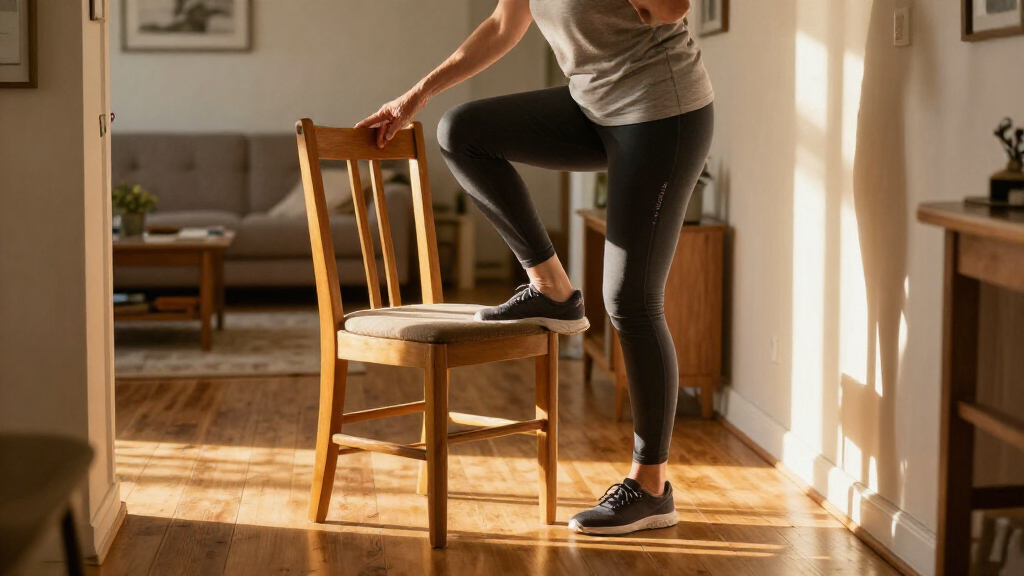
Fit&Well says to attempt the check only with safety precautions: wear supportive, non-slip shoes, clear the area, have another person nearby and stand close to a sturdy counter or other support. People who have recently fallen, feel notably unsteady, or cannot safely stand and walk across a room should seek a professional assessment first. Stop if pain, dizziness, faintness, unusual breathlessness or loss of balance occurs.
When a Balance Check Warrants Follow-Up
Difficulty with one or more positions may provide a reason to ask a doctor or physical therapist for advice, particularly if balance is worsening or affecting walking and everyday activities. The source says the CDC identifies inability to hold the heel-to-toe position for at least 10 seconds as an indicator of higher fall risk. That is a screening signal, not a prediction that a person will fall or evidence of a specific condition.
The check matters because balance is only one contributor to falling. Ulishchenko notes that strength, eyesight, medication, blood pressure and the home environment can also affect risk. Passing the test therefore does not rule out other concerns. A clinician can consider those factors alongside a person’s history and decide whether further assessment or tailored support is appropriate.
Popular right now

Roborock Qrevo S Pro Robot Vacuum and Mop with 18,500 Pa Suction

Dyson V15 Detect Cordless Vacuum Cleaner, Yellow/Nickel

Apple AirPods Pro (1st Generation) with MagSafe Charging Case
As an affiliate, we earn on qualifying purchases.
How the Three Positions Progress
The home version described by Fit&Well is adapted from the CDC’s four-stage balance assessment. Ulishchenko recommends omitting the fourth stage, a single-leg stand, in line with the source’s account of CDC guidance for remote assessment. The three remaining positions progress from feet together to semi-tandem and then heel-to-toe, narrowing the base of support as the test advances.
Fit&Well presents the check as a brief way to notice standing-balance difficulty, not as a substitute for an examination. Ulishchenko says people who struggle with any position should consider discussing it with a health professional, especially if they have also noticed changes in their walking, confidence or ability to manage usual activities. Those who have fallen more than once, been injured in a fall or have trouble getting up after falling are advised to ask about a comprehensive falls assessment.
“Maintaining your strength and balance is not simply about reducing the likelihood of a fall. It’s also about preserving your confidence, independence and ability to keep doing the things you enjoy.”
— Ales Ulishchenko, licensed osteopathy practitioner, as quoted by Fit&Well
What the Home Test Cannot Establish
The source does not provide evidence that this home check can predict whether an individual will fall, identify why someone is unsteady or replace a clinical assessment. It describes inability to hold the heel-to-toe stance for 10 seconds as an indicator of higher risk, but the result should not be treated as a diagnosis. Nor does completing all three positions show that fall risk is absent.
The supplied report does not include study results, accuracy figures or a publication date. It also does not specify how age, health conditions or other individual circumstances affect interpretation of a result. Anyone concerned about worsening balance, a recent fall or difficulty with daily activities should seek individualized guidance rather than relying on the test alone.
Discuss Concerns With a Clinician
People who struggle with a position should stop and consider sharing that result with a doctor or physical therapist. The source also recommends professional advice for worsening balance, increasing unsteadiness while walking or turning, reliance on furniture or other people for support, or growing difficulty with everyday tasks. After repeated falls, an injury, or trouble getting up from the floor, it advises asking a doctor about a comprehensive falls assessment.
For people who are already practising balance safely, Ulishchenko suggests that a home retest after four to six weeks of regular practice can be a practical way to track change, while stressing that this interval is not a fixed rule. People who are particularly unsteady or have a history of falls should ask a physical therapist or falls-prevention professional to recommend suitable exercises and a safe starting level.
Key Questions
What are the three positions in the home balance test?
The positions are feet together, semi-tandem—with the instep of one foot beside the other foot’s big toe—and heel-to-toe, with the front heel touching the back toes. The source describes holding each for up to 10 seconds before progressing, if safe.
What does it mean if I cannot hold the heel-to-toe position for 10 seconds?
The source says the CDC identifies this difficulty as an indicator of higher fall risk. It does not mean a fall is certain or establish a medical condition. Consider discussing the result with a doctor or physical therapist, especially if you have other balance concerns.
Is it safe to try the test alone?
Fit&Well recommends having another person nearby, clearing the space, wearing non-slip shoes and standing near a sturdy support. People who have recently fallen, feel notably unsteady or cannot safely stand and walk across a room should seek professional assessment first.
Does passing the test mean I will not fall?
No. The source says completing all three stages does not guarantee that someone will not fall. Balance is only one factor; strength, eyesight, medication, blood pressure and the home environment may also affect risk.
When should I talk to a doctor about balance?
Seek advice if balance is getting worse, walking or turning feels increasingly unsteady, you have fallen, you regularly need support, or everyday activities are becoming harder. The source recommends asking about a comprehensive falls assessment after repeated falls, an injury, or difficulty getting up after a fall.
Source: fitandwell.com