
Solar panel kits range from 10-watt battery trickle chargers to 10kW whole-home off-grid systems, and the biggest mistake buyers make is shopping by panel wattage alone — what actually separates kits is whether the charge controller, inverter, and battery storage are matched to your real consumption. For most buyers serious about off-grid power, the ECO-WORTHY 400W kit with 200Ah lithium batteries and a 2000W inverter is the strongest all-around pick because it delivers a genuinely usable complete system, not just panels and a controller. If you want expandability and better charging efficiency on a smaller budget, the Renogy 400W Premium kit with a 40A MPPT controller is the smarter foundation, while the SOLPERK 20W kit handles battery-maintenance duty for under fifty watts of need. The core tradeoff in this category is convenience versus headroom: complete kits with batteries cost more upfront but avoid compatibility headaches, while panel-and-controller kits are cheaper and more flexible but demand more planning. Keep reading for the full breakdown, including who each kit is actually for.

Turn your wind-down time into listening time
- Thousands of audiobooks, podcasts and originals
- Listen on your phone, tablet or Echo — also offline
- Cancel anytime
Key Takeaways
- Complete kits with matched batteries and inverters (the two ECO-WORTHY 400W lithium systems) outperform panel-only kits for first-time off-grid buyers because every component is sized to work together — no controller-voltage or inverter-load guesswork.
- MPPT versus PWM is the hidden cost divider: the Renogy 400W Premium kit’s 40A MPPT controller harvests noticeably more energy in low light and cold weather than the PWM controllers in similarly priced 200–400W kits, which matters more as panel count grows.
- The 10kW ECO-WORTHY systems differ mainly in battery capacity and safety certifications — the version with UL 1741, UL 1973, and UL 9540A listings is the only one of the three I’d recommend for permitted residential installations.
- Small maintainer kits (SOLPERK 20W, SOLPERK 100W, and the generic 100W maintainer) are frequently bought by mistake for loads they can’t support; they’re for keeping parked-vehicle batteries alive, not running appliances.
- N-type panels now appear across Renogy and ECO-WORTHY mid-size kits and hold efficiency better in heat and shade than the monocrystalline panels in older starter kits — a real advantage for roof-mounted RV installations.
| ECO-WORTHY 400W 12V Solar Panel Kit with 200Ah Lithium Batteries and 2000W Inverter | 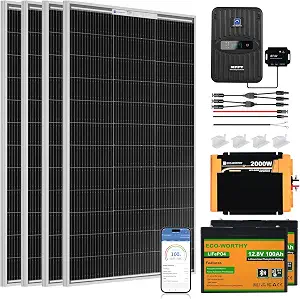 | Best Complete Off-Grid System | Solar panel capacity: 400W (4 × 100W bifacial panels) | Battery capacity: 2 × 12V 100Ah lithium batteries | Charge controller: 40A MPPT | VIEW ON AMAZON | See Our Full Breakdown |
| SOLPERK 20W 12V Solar Panel Kit with 8A Controller and Adjustable Mount Bracket |  | Best Battery Maintainer | Power: 20 watts | Output voltage: 12 volts | Controller: 8A with three-stage charging | VIEW ON AMAZON | See Our Full Breakdown |
| 200 Watt N-Type Solar Panel Kit (Single Panel, 25% Efficiency) |  | Best Panel Efficiency | Power output: 200W | Panel type: N-type, single board | Conversion efficiency: 25% | VIEW ON AMAZON | See Our Full Breakdown |
| Renogy 400W Premium Solar Kit with 40A MPPT Charge Controller |  | Best for System Builders | Total power: 400 watts (4 × 100W) | Panel type: Monocrystalline silicon | Charge controller: 40A MPPT | VIEW ON AMAZON | See Our Full Breakdown |
| SOLPERK 100W 12V Solar Battery Charger and Maintainer |  | Best Mid-Size Maintainer | Panel power: 100W monocrystalline | Output voltage: 12V DC (20V max) | Charge controller: 10A MPPT | VIEW ON AMAZON | See Our Full Breakdown |
| ECO-WORTHY 10kW Off-Grid Solar Panel Kit with 16.1kWh Battery |  | Best for Split-Phase Backup | Inverter output: 10,000W continuous; up to 20,000W peak | Output voltage: 120V or 120V/240V split-phase | Solar panels: 5 × 590W monocrystalline panels | VIEW ON AMAZON | See Our Full Breakdown |
| ZOUPW 220W Solar Panel Kit for 12V/24V Battery with 30A LCD PWM Charge Controller |  | Best All-in-One Small-System Kit | Total panel power: 220W (2 × 110W) | Cell type: N-Type monocrystalline, 16 busbar | Cell efficiency: 25% | VIEW ON AMAZON | See Our Full Breakdown |
| Renogy 200W 12V N-Type RV Solar Panel Kit with Adventurer 30A Controller |  | Best for RV Roof Installation | Power: 200W | Output voltage: 12V DC | Controller: Adventurer-Li 30A PWM | VIEW ON AMAZON | See Our Full Breakdown |
| Renogy 100W 12V Solar Panel Starter Kit with 30A PWM Wanderer Charge Controller |  | Best Starter Kit for Small 12V Setups | Power output: 100W | System voltage: 12V | Cell efficiency: 22.5% | VIEW ON AMAZON | See Our Full Breakdown |
| ECO-WORTHY 10kW Off-Grid Solar System Kit with 5,310W Panels and 20.48kWh Battery Storage |  | Best for Higher Daily Energy Needs | Inverter output: 10,000W continuous; up to 20,000W peak | Output voltage: 120V/240V split-phase | Solar panels: 9 × 590W bifacial panels | VIEW ON AMAZON | See Our Full Breakdown |
| ECO-WORTHY 10KW Off-Grid Solar System Complete Kit |  | Best for Full-Home Off-Grid Power | Max Output Power: 10,000W (parallel up to 60KW) | Daily Energy Production: 9.36 KWH (4 hrs full sun) | Solar Array: 12 x 195W N-Type bifacial panels (2,340W) | VIEW ON AMAZON | See Our Full Breakdown |
| ECO-WORTHY 200W 12V/24V Solar Panel Kit with 30A PWM Charge Controller |  | Best Value Starter Kit | Power Output: 200W | Voltage: 12V/24V | Cell Efficiency: 21.5% | VIEW ON AMAZON | See Our Full Breakdown |
| ECO-WORTHY 400W Solar Panel Kit (4 x 100W N-Type Monocrystalline) |  | Best Panel Efficiency per Dollar | Total Power: 400W (4 x 100W) | Cell Type: N-Type monocrystalline, bifacial | Conversion Efficiency: 25% | VIEW ON AMAZON | See Our Full Breakdown |
| 100W 12V Solar Panel Battery Maintainer Kit with Charge Controller |  | Best Battery Maintenance Pick | Power Output: 100W | Cell Type: Monocrystalline silicon | Battery Compatibility: 12V batteries | VIEW ON AMAZON | See Our Full Breakdown |
| Renogy 200W 12V Monocrystalline Solar Panel Kit with 30A PWM Charge Controller |  | Best for Battery Chemistry Flexibility | Power Output: 200W | System Voltage: 12V | Cell Efficiency: 22% | VIEW ON AMAZON | See Our Full Breakdown |
More Details on Our Top Picks
ECO-WORTHY 400W 12V Solar Panel Kit with 200Ah Lithium Batteries and 2000W Inverter
This option stands out for being the only kit in this lineup that ships with everything needed to actually power AC appliances — four bifacial panels, 200Ah of lithium storage, a 40A MPPT controller, and a 2000W pure sine wave inverter. Compared with the Renogy 400W Premium Solar Kit, which offers similar panel capacity but no batteries or inverter, this ECO-WORTHY bundle saves you from sourcing and matching components yourself. The built-in battery management system and Bluetooth module add real-world convenience for monitoring. The tradeoff: the listing’s daily energy output claims are inconsistent, so buyers should size expectations conservatively, and the 23% panel conversion rate trails the 25% claimed by the N-type 200W panel elsewhere in this roundup.
Pros:- Truly complete system: panels, lithium batteries, MPPT controller, and pure sine wave inverter included
- Lithium batteries with built-in BMS rated for 3000+ deep cycles
- Pure sine wave inverter safely runs sensitive electronics and AC appliances
- Bluetooth monitoring lets you check charge status from a phone
Cons:- Daily output figures in the product listing are inconsistent and should be treated cautiously
- 12V system architecture limits expansion compared with 48V whole-home kits
- Real-world generation depends heavily on sunlight and installation conditions
Best for: Cabin, RV, or shed owners who want a single purchase covering generation, storage, and AC power without mixing brands
Not ideal for: Buyers who already own batteries or an inverter — they’d be paying twice for components they don’t need
- Solar panel capacity:400W (4 × 100W bifacial panels)
- Battery capacity:2 × 12V 100Ah lithium batteries
- Charge controller:40A MPPT
- Inverter:12V, 2000W pure sine wave
- Conversion rate:23%
- Battery cycle life:More than 3000 deep cycles
- Connectivity:Bluetooth Module 5.0
Our verdict“This is the pick for anyone who wants a working off-grid power system out of one box rather than a component-shopping project.”
SOLPERK 20W 12V Solar Panel Kit with 8A Controller and Adjustable Mount Bracket
Where most kits in this roundup aim to power devices, this one has a narrower, more practical job: keeping a stored battery alive. At 20W, it sits at the small end of the spectrum — the SOLPERK 100W maintainer covers faster charging, but for a vehicle that sits for weeks, 20W is enough to offset natural discharge. The three-stage 8A controller prevents the overcharging that ruins lead-acid batteries, and the 360-degree adjustable bracket matters more here than on larger kits because you’ll want to fine-tune the angle seasonally. Build quality is a genuine strength: low-iron tempered glass and an aluminum frame rated for 2400Pa wind and 5400Pa snow loads. The main limitation is awareness — the controller has indicator lights only, so you can’t read actual charge levels without adding a meter.
Pros:- Smart three-stage controller protects against overcharging, over-voltage, and short circuits
- Works with virtually every 12V battery chemistry, including LiFePO4, AGM, GEL, and SLA
- Weatherproof build rated for 2400Pa wind and 5400Pa snow with a 25-year lifespan
- Plug-and-play installation with alligator clips and a fully adjustable mounting bracket
Cons:- 20W output only maintains batteries; it cannot recharge a deeply discharged one quickly
- No digital display — just indicator lights, so charge state is approximate
Best for: Owners of stored cars, boats, tractors, or trailers who need to prevent battery drain over weeks or months
Not ideal for: Anyone hoping to run devices — 20W is trickle-charging power, not appliance power
- Power:20 watts
- Output voltage:12 volts
- Controller:8A with three-stage charging
- Cell type:Monocrystalline A+ silicon
- Wind/snow tolerance:2400Pa wind, 5400Pa snow
- Weight:3 pounds
- Lifespan:Up to 25 years
Our verdict“If your goal is keeping a parked vehicle’s battery healthy through winter rather than generating usable power, this is the right tool for the job.”
200 Watt N-Type Solar Panel Kit (Single Panel, 25% Efficiency)
This kit takes a different engineering approach than its 200W peers: instead of pairing two 100W panels, it uses one large N-type board. That single-board design eliminates the connection losses between panels, which the maker claims yields 12% more power than dual 100W kits — a direct jab at options like the ECO-WORTHY 200W kit and Renogy 200W monocrystalline kit in this roundup. The bigger practical win is cloudy-day performance: N-type cells degrade less in diffuse light, with a claimed 35% efficiency advantage over standard panels in poor conditions. For anyone in a region with frequent overcast weather, that difference compounds daily. The tradeoffs are modest but real — it’s a panel-and-connections kit rather than a full system like the ECO-WORTHY 400W bundle, and expansion tops out at three panels in series or parallel.
Pros:- Single-board design avoids inter-panel connection losses found in dual 100W kits
- 25% conversion efficiency leads this roundup’s standard panels
- 35% better performance claimed on cloudy days thanks to N-type cells
- Expandable to three panels in parallel or series
Cons:- Requires regular inspection and cleaning to sustain peak output
- Expansion capped at three panels
- No controller, battery, or inverter included
Best for: Off-grid builders in cloudy climates who want maximum harvest from a limited roof or rack footprint
Not ideal for: Buyers wanting a turnkey system with batteries and inverter included — this is generation only
- Power output:200W
- Panel type:N-type, single board
- Conversion efficiency:25%
- Average daily generation:1000Wh+ with 5-6 hours of sunshine
- Max parallel connection:3 panels
- Max series connection:3 panels
Our verdict“This panel makes the most sense for efficiency-focused builders, especially where overcast skies make every percentage point of conversion matter.”
Renogy 400W Premium Solar Kit with 40A MPPT Charge Controller
This kit earns its place as the most trusted starting point for a custom system. Unlike the ECO-WORTHY 400W kit with batteries, Renogy sells you the generation and charge-management layer only — four monocrystalline panels, a 40A MPPT controller, Z-brackets, and cables — leaving battery and inverter choices to you. That’s a genuine advantage for builders who want to pick their own lithium chemistry or scale to 24V later, since the controller supports up to 32V battery banks. The Bluetooth monitoring module matches what ECO-WORTHY offers, but Renogy’s controller ecosystem is widely documented, which matters when troubleshooting. Two things hold it back: at 56.4 pounds across four panels, a solo rooftop installation is awkward, and the warranty requires a separate request through customer service rather than registering automatically.
Pros:- Complete generation kit with panels, MPPT controller, brackets, and cables included
- 40A MPPT controller supports 12V and higher battery banks up to 32V
- Bluetooth phone monitoring included
- Renogy’s component ecosystem is well documented for future expansion
Cons:- At 56.4 pounds across four panels, installation is a two-person job on a roof
- Warranty must be requested separately through customer service
- No battery or inverter included at this tier
Best for: DIY off-grid builders who want proven components and plan to choose their own batteries and inverter
Not ideal for: First-time buyers who want everything in one purchase — batteries and inverter must be sourced separately
- Total power:400 watts (4 × 100W)
- Panel type:Monocrystalline silicon
- Charge controller:40A MPPT
- Output voltage:12V
- Max battery voltage:32V
- Connectors:MC4
- Weight:56.4 pounds
Our verdict“This is the kit for someone who already knows what batteries and inverter they want and needs a reliable, expandable solar foundation to build on.”
SOLPERK 100W 12V Solar Battery Charger and Maintainer
This kit occupies the middle ground between the 20W SOLPERK maintainer and full power kits like the Renogy 100W starter kit. The 100W panel with a 10A MPPT controller is enough to maintain a large battery bank and slowly recharge one that’s been drained — something the 20W version simply can’t do in reasonable time. The MPPT controller (rather than the PWM controllers common at this price tier) extracts more power in low-light mornings and evenings, and it includes multi-layer battery protection. Compared with the smaller SOLPERK, the upgrade brings MC4 connectors and a sturdier tempered glass and aluminum panel suited to permanent mounting on a shed or boat. One caveat: the listing’s 30% efficiency and 400Wh daily figures come from the manufacturer’s own test conditions and aren’t independently verified, so treat output claims as optimistic upper bounds.
Pros:- MPPT controller outperforms the PWM controllers typical at this size and includes battery protection
- Sufficient output to recharge a drained 12V battery, not just maintain it
- Pre-drilled panel and plug-and-play MC4 connections make installation straightforward
- Tempered glass and aluminum construction suited to permanent outdoor mounting
Cons:- Claimed 30% efficiency and 400Wh daily output are not independently verified
- Single 100W panel limits capacity for larger battery banks
Best for: Boat, RV, and shed owners who need faster battery maintenance and light top-up charging beyond trickle level
Not ideal for: Anyone expecting to run appliances — 100W maintains and tops up, it doesn’t power a household load
- Panel power:100W monocrystalline
- Output voltage:12V DC (20V max)
- Charge controller:10A MPPT
- Cell count:54
- Connectors:MC4
- Panel material:Monocrystalline silicon, tempered glass, aluminum
- Warranty:1 year after-sale service; lifetime technical support
Our verdict“This is the right step up when the 20W maintainer is too slow but a full off-grid kit is more system than you need.”
ECO-WORTHY 10kW Off-Grid Solar Panel Kit with 16.1kWh Battery
Split-phase output and a 16.1kWh battery make this kit a fit for buyers planning a substantial off-grid system with both 120V and 240V loads. Its 10,000W continuous inverter has more output headroom than the smaller RV kits in this roundup, while the included five panels provide 2,950W of solar capacity to replenish storage. Compared with the ECO-WORTHY 10kW kit with 5,310W of panels and 20.48kWh of storage, this version includes less generation capacity and a smaller battery, so it suits a setup with lower daily energy needs. The tradeoff is that the high-capacity components call for professional installation, and truck delivery on a pallet requires suitable access. I’d shortlist it for buyers who value split-phase capability and an all-in-one component package.
Pros:- Includes panels, inverter, battery, and cables in one kit
- 16.076kWh LiFePO₄ battery provides substantial energy storage
- 10,000W continuous inverter supports 120V/240V split-phase output
- Display, Bluetooth, Wi-Fi, and PC monitoring options
Cons:- The 2,950W panel array is smaller than the 5,310W array in the other ECO-WORTHY 10kW kit
- Professional installation is recommended
- Palletized truck delivery requires accessible unloading space
Best for: Off-grid property owners who need 120V/240V output and substantial battery storage for household loads
Not ideal for: Buyers with high daily energy use who need faster solar recharging, or those without room and access for pallet delivery
- Inverter output:10,000W continuous; up to 20,000W peak
- Output voltage:120V or 120V/240V split-phase
- Solar panels:5 × 590W monocrystalline panels
- Total PV capacity:2,950W
- Daily energy generation:Up to 11.8kWh under optimal conditions
- Battery:48V 314Ah LiFePO₄; 16.076kWh
- Battery management:PACE 200A BMS
- Monitoring:7-inch display, Bluetooth, Wi-Fi, and PC connectivity
Our verdict“Choose this kit for a professionally installed off-grid system that needs split-phase power and 16.1kWh of storage, with moderate rather than maximum solar input.”
ZOUPW 220W Solar Panel Kit for 12V/24V Battery with 30A LCD PWM Charge Controller
Panels, controller, brackets, and cables arrive as one kit, making this a more complete starting point than the Renogy 100W starter kit, which has half the panel capacity. Two 110W N-Type panels are rated at 25% efficiency, and the controller can work with 12V or 24V batteries and several battery chemistries. That combination gives RV, boat, and cabin owners flexibility as their setup takes shape; the listed daily generation is up to 1.1kWh with five hours of full sun, not a guaranteed everyday yield. The main compromise is the PWM controller, which is less efficient than MPPT charging, including the controller in the Renogy 400W Premium Solar Kit. At 220W, it also remains a small-system choice: buyers running larger loads will need more panel capacity.
Pros:- Includes panels, controller, mounting hardware, and cables
- 25% rated efficiency N-Type monocrystalline panels
- Controller supports 12V and 24V batteries and multiple battery types
- IP68-rated panels with corrosion-resistant aluminum frames
Cons:- PWM charging is less efficient than MPPT alternatives
- 220W panel capacity may not cover higher daily energy demands
- The stated daily output depends on receiving five hours of full sunlight
Best for: RV, boat, and small-cabin owners who want a ready-to-mount 220W array for a 12V or 24V battery system
Not ideal for: People powering high-demand appliances or seeking the extra charging efficiency of an MPPT controller
- Total panel power:220W (2 × 110W)
- Cell type:N-Type monocrystalline, 16 busbar
- Cell efficiency:25%
- Charge controller:30A PWM with LCD and automatic 12V/24V sensing
- Battery compatibility:Lithium, gel, sealed, and flooded
- Maximum controller input:400W
- Daily output:Up to 1.1kWh with five hours of full sunlight
- Panel warranty:10 years
Our verdict“Pick this kit for a compact, broadly compatible 220W setup when an included PWM controller is acceptable.”
Renogy 200W 12V N-Type RV Solar Panel Kit with Adventurer 30A Controller
Pre-drilled mounting holes and plug-and-play MC4 cables make this a straightforward choice for RV owners planning a fixed 200W roof array. Its 30A controller supports lithium, lead-acid, and gel batteries, while the weather-resistance and load ratings give buyers useful information when comparing equipment for exposed installations. Against the ZOUPW 220W kit, Renogy supplies 20W less panel capacity and lists 22% cell efficiency rather than 25%; the ZOUPW kit also includes mounting hardware. Renogy’s advantage here is a clearly specified panel format and a design aimed at RV and marine mounting. The key limitation is that its included controller uses PWM charging, so buyers seeking more efficient battery charging may prefer the Renogy 400W Premium Solar Kit with MPPT. Output also varies with sun exposure.
Pros:- Pre-drilled mounting holes and plug-and-play cables simplify installation
- 30A controller supports lithium, lead-acid, and gel batteries
- IP67 protection and specified wind and snow load resistance
- MC4 connectors suit common solar wiring setups
Cons:- Included Adventurer-Li controller uses PWM charging
- 200W capacity is below the 220W ZOUPW kit and may limit daily energy harvest
- Daily output depends on available sunlight
Best for: RV and camper owners fitting a 200W array to a 12V battery system with multiple supported battery chemistries
Not ideal for: Buyers who want MPPT charging, higher panel output, or mounting hardware explicitly included in the kit
- Power:200W
- Output voltage:12V DC
- Controller:Adventurer-Li 30A PWM
- Solar cell efficiency:22%
- Estimated daily output:800Wh with four hours of sunlight
- Dimensions:41.8 × 20.9 × 1.4 in
- Weight:16.5 lb
- Warranty:5 years
Our verdict“Choose this kit for a roof-mounted 200W RV system when its simple connections and battery compatibility matter more than MPPT charging.”
Renogy 100W 12V Solar Panel Starter Kit with 30A PWM Wanderer Charge Controller
A 100W panel and 30A controller make this a modest entry point for maintaining a small 12V battery setup or adding limited charging to a compact off-grid system. The controller supports AGM, gel, flooded, and lithium batteries, and the listed expansion ceiling is 400W, so buyers can add panel capacity later. Compared with the Renogy 200W kit, this starter set begins at half the panel output; its average daily generation is listed as 500Wh, which will not suit heavy appliance use. Its certifications and stated weather-load ratings are useful selection details for fixed outdoor installations. Remote monitoring requires a separately purchased Bluetooth module, and the included PWM controller gives up charging efficiency available from MPPT kits. I’d choose it for a simple, expandable start, not as a complete power source for a busy RV.
Pros:- 30A controller supports AGM, gel, flooded, and lithium batteries
- Panel array can expand to 400W
- Panel safety certifications include UL, CSA, and IEC standards
- Specified wind and snow load resistance supports outdoor installation
Cons:- 100W starting capacity is limited compared with the Renogy 200W kit
- Remote monitoring requires a separately purchased Bluetooth module
- Included PWM controller is less efficient than MPPT charging
Best for: First-time solar users maintaining a small 12V battery bank who want room to expand the array
Not ideal for: RV owners with substantial daily loads or buyers who want built-in remote monitoring and MPPT charging
- Power output:100W
- System voltage:12V
- Cell efficiency:22.5%
- Average daily generation:500Wh, depending on sunlight
- Charge controller:Wanderer 30A PWM
- Maximum expansion:400W
- Battery compatibility:AGM, gel, flooded, and lithium
- Certifications:UL 61730, CSA C22.2#61730, IEC 61730, and IEC 61215
- Panel warranty:10 years material and workmanship; 25 years power output
Our verdict“This is a sensible starter kit for small 12V battery needs if you plan to expand later and can work without included remote monitoring.”
ECO-WORTHY 10kW Off-Grid Solar System Kit with 5,310W Panels and 20.48kWh Battery Storage
5,310W of panels and 20.48kWh of storage give this ECO-WORTHY system the largest stated solar array and battery in this batch. Nine 590W panels pair with a 10,000W continuous inverter, supporting a more energy-intensive off-grid plan than the ECO-WORTHY 10kW kit with five panels and 16.1kWh storage. Its bifacial panels may add output when the rear side receives reflected light, though that boost depends on installation conditions. The four-battery configuration spreads storage across separate units, and the system lists Wi-Fi monitoring and multiple inverter protections. This capacity comes with practical demands: the large panels need accessible truck delivery, and professional installation is recommended. I’d favor it when greater generation and storage are worth the added installation and site-planning effort.
Pros:- 5,310W panel array exceeds the other ECO-WORTHY 10kW kit in this batch
- 20.48kWh of LiFePO₄ storage
- 10,000W continuous inverter with 120V/240V split-phase output
- Bifacial panels, Wi-Fi monitoring, and inverter protections are included
Cons:- Large panels require substantial installation space and accessible truck delivery
- Professional installation is recommended
- Potential bifacial output gain depends on reflected light and site conditions
Best for: Off-grid homeowners with higher daily energy requirements who have space for a large array and professional installation
Not ideal for: Small cabins, RV users, or sites without room for large panels and access for palletized truck delivery
- Inverter output:10,000W continuous; up to 20,000W peak
- Output voltage:120V/240V split-phase
- Solar panels:9 × 590W bifacial panels
- Total PV capacity:5,310W
- Battery storage:20.48kWh
- Battery configuration:4 × 48V 100Ah LiFePO₄ batteries
- Panel efficiency:23.23%
- Panel dimensions:89.7 × 44.6 × 1.4 in
- Battery protection:100A BMS and 125A circuit breaker
Our verdict“Choose this system for a professionally installed off-grid property that needs more panel capacity and storage than the smaller ECO-WORTHY 10kW option.”
ECO-WORTHY 10KW Off-Grid Solar System Complete Kit
This kit sits at the opposite end of the spectrum from the ECO-WORTHY 200W PWM kit — it is a genuine whole-house solution, not a weekend project. With a 10KW split-phase inverter, 2,340W of bifacial panels, and two UL-certified 48V lithium batteries, it can run air conditioners, well pumps, and refrigerators simultaneously, which no battery-maintainer or 200W starter kit can approach. The UL 1741, UL 1973, and UL 9540A certifications also put it ahead of the smaller ECO-WORTHY 10kW kit with 5,310W panels on paper, at least for permitting and insurance purposes. The tradeoff is real: professional installation is mandatory, and the 9.36KWH/day estimate assumes four hours of full sun, so cloudy winters will require the mains-charging fallback.
Pros:- Complete all-in-one package: panels, inverter, batteries, and mounting hardware
- Multiple UL and CEC certifications for safety and permitting
- Scalable up to 60KW by paralleling six inverters
- Flexible charging modes with true UPS backup capability
Cons:- Professional installation required — not a DIY product
- Daily output estimates depend on four hours of full sunshine
- Limited online technical guidance beyond remote support
Best for: Homeowners, farmers, or cabin dwellers cutting ties with the grid entirely and running 120V/240V appliances
Not ideal for: DIYers and RV owners — it demands professional installation and far exceeds mobile power needs
- Max Output Power:10,000W (parallel up to 60KW)
- Daily Energy Production:9.36 KWH (4 hrs full sun)
- Solar Array:12 x 195W N-Type bifacial panels (2,340W)
- Battery:2 x 48V 100AH lithium server rack batteries
- Inverter Output:120V/240V AC split-phase
- Cell Efficiency:25%
- Certifications:UL 1741, UL 1973, UL 9540A, CEC
- Panel Lifespan:30 years
Our verdict“This pick makes the most sense for buyers replacing utility service at a remote property, not hobbyists tinkering with a 12V battery.”
ECO-WORTHY 200W 12V/24V Solar Panel Kit with 30A PWM Charge Controller
For buyers who want meaningful off-grid power without the invoice of a Renogy 400W Premium kit with MPPT controller, this 200W bundle hits a practical middle ground. The two monocrystalline panels deliver 21.5% cell efficiency and frames rated for 2400Pa wind and 5400Pa snow loads, so roof-mounting on an RV or boat is realistic. Compared with the Renogy 200W 12V kit, the standout difference is flexibility: series wiring for 24V or parallel for 12V, versus Renogy’s fixed 12V system. The catch is the 30A PWM controller, which wastes harvest compared to MPPT — buyers planning to expand the array later should budget for a controller swap, since PWM losses compound as you add panels.
Pros:- Dual 12V/24V configuration flexibility
- Rugged frames rated for heavy wind and snow loads
- Complete kit: panels, controller, brackets, and 16.4ft cables
- 24/7 tech support included
Cons:- PWM controller noticeably less efficient than MPPT alternatives
- Real-world daily output falls short of the 800Wh estimate without ideal sun
Best for: RV owners and boaters building a first 12V or 24V setup on a budget
Not ideal for: Growers — anyone planning to expand past 400W will outgrow the PWM controller quickly
- Power Output:200W
- Voltage:12V/24V
- Cell Efficiency:21.5%
- Daily Output:~800Wh (4 hrs full sun)
- Charge Controller:30A PWM
- Solar Cable:16.4ft 10 AWG
- Warranty:1 year
Our verdict“A sensible entry point for mobile off-grid power, provided you accept the PWM efficiency ceiling.”
ECO-WORTHY 400W Solar Panel Kit (4 x 100W N-Type Monocrystalline)
Where the ECO-WORTHY 200W kit uses conventional P-type cells at 21.5% efficiency, this 400W set jumps to N-type bifacial panels at 25% conversion — the same cell technology found in the brand’s whole-house 10KW system, just scaled down. The practical payoff is better low-light and shade performance thanks to bypass diodes and rear-side gain from the bifacial glass, which matters on partially shaded RV roofs or forested campsites. One annoyance: the four panels ship in two separate boxes, so don’t plan an install weekend until everything has actually arrived. And unlike the ECO-WORTHY 200W bundle, this kit includes no charge controller, so you’ll need to supply your own — a plus for anyone already upgrading to MPPT, a minus for true beginners.
Pros:- 25% efficiency from N-type bifacial cells with 16BB busbars
- IP68 junction box and bypass diodes handle shade and low light well
- Pre-drilled holes make mounting straightforward
- Works with 12V/24V on-grid, off-grid, and hybrid setups
Cons:- Panels arrive in two separate shipments that may not sync
- N-type bifacial panels carry a premium over standard P-type options
- No charge controller included
Best for: Intermediate DIYers upgrading an existing system who want premium panel tech without repurchasing a controller
Not ideal for: Complete beginners — no charge controller or battery cables are included, so it isn’t truly plug-and-play out of the box
- Total Power:400W (4 x 100W)
- Cell Type:N-Type monocrystalline, bifacial
- Conversion Efficiency:25%
- Connector:MC4
- Cable Length:35 inches per panel
- Panel Dimensions:35.63 x 23.03 x 1.18 in
- Total Weight:23.8 pounds
Our verdict“The strongest panel technology in the mid-size class, best paired with your own MPPT controller.”
100W 12V Solar Panel Battery Maintainer Kit with Charge Controller
This kit occupies the same maintenance niche as the SOLPERK 100W battery charger and maintainer, but differentiates itself with a smart controller featuring an LCD display and USB ports — useful for charging phones directly at a campsite without draining the house battery. At 100W, it’s designed to keep a 12V battery topped off rather than power appliances, a job it handles with solid low-light monocrystalline performance and full four-way protection against overcharge, over-discharge, over-voltage, and shorts. Compared with the larger ECO-WORTHY 200W kit, this option stands out for simplicity: everything needed for a basic install — cables, O-ring terminals, Z-brackets, screws — is in one box, with no wiring decisions to make. Its ceiling is equally clear: 12V systems only, and anything beyond light loads needs more panels.
Pros:- Smart LCD controller with USB charging and full battery protection
- Truly complete kit — nothing extra to buy
- Weatherproof build handles hail, snow, and rain
- Good low-light monocrystalline output
Cons:- Limited to 12V battery systems only
- Insufficient capacity for anything beyond battery maintenance and light loads
Best for: Boat, RV, and tractor owners who need to keep a stored 12V battery healthy over winter
Not ideal for: Anyone running appliances — 100W is maintenance-level power, not enough for inverters or refrigeration
- Power Output:100W
- Cell Type:Monocrystalline silicon
- Battery Compatibility:12V batteries
- Controller:Smart controller with LCD and USB ports
- Protection:Overcharge, over-discharge, over-voltage, short-circuit
- Included Hardware:Cables, O-ring terminals, Z-brackets, screws
Our verdict“A fit-and-forget solution for keeping idle 12V batteries charged, not a power system for living off-grid.”
Renogy 200W 12V Monocrystalline Solar Panel Kit with 30A PWM Charge Controller
The Wanderer 30A controller here is what separates this kit from the nearly identical ECO-WORTHY 200W kit: it supports Sealed, Gel, Flooded, and Lithium batteries with four-stage charging, making it the safer choice if you might switch battery types later — say, moving from lead-acid to lithium on a camper build. At 22% cell efficiency it edges out ECO-WORTHY’s 21.5%, and the array is expandable to 400W without replacing the controller. Both 200W kits share the same weakness: PWM charging wastes harvest compared with the MPPT controller in Renogy’s own 400W Premium kit, and the ~1000Wh/day figure assumes five hours of ideal sun. This model is better suited to gradual, budget-conscious expansion than maximum daily harvest.
Pros:- Controller supports four battery chemistries including lithium
- 4-stage charging with overcharge, overload, short-circuit, and reverse-polarity protection
- Expandable to 400W on the same controller
- All cables, Z-brackets, and pre-drilled panels included
Cons:- PWM controller less efficient than MPPT alternatives
- Daily output estimate assumes five hours of direct sun
Best for: Camper van builders who may upgrade from lead-acid to lithium batteries without replacing their controller
Not ideal for: Harvest maximizers — MPPT-equipped kits like the Renogy 400W Premium extract more power from the same sunlight
- Power Output:200W
- System Voltage:12V
- Cell Efficiency:22%
- Daily Output:~1000Wh (5 hrs direct sun)
- Charge Controller:Wanderer Li 30A PWM
- Compatible Batteries:Sealed, Gel, Flooded, Lithium
- Expandable Capacity:Up to 400W
Our verdict“The most future-proof 200W starter kit for battery chemistry flexibility, at the cost of PWM efficiency.”

How We Picked
I evaluated these fifteen kits against the criteria that actually determine whether a solar kit succeeds or disappoints: system completeness (does the kit include matched controller, inverter, and battery storage, or just panels?), charge controller quality (MPPT versus PWM, and whether the amperage rating leaves room to add panels later), panel technology (N-type and bifacial versus standard monocrystalline), and realistic output for the intended use — an RV, a shed, a parked vehicle, or a full off-grid home have completely different power profiles. I also weighed installation burden, since a kit that requires a licensed electrician is a different product category from one that mounts with brackets and MC4 connectors.
The ranking order reflects a simple logic: complete, well-matched systems that a buyer can install and rely on rank highest, expandable panel-and-controller foundations rank in the middle, and specialty kits (tiny maintainers, permitted-installation whole-home systems) rank where their niche demand sits. Where two kits look similar on paper — such as the three ECO-WORTHY 10kW systems — I separated them by battery capacity, inverter output, and safety certifications, because those differences decide which one belongs on a house versus a cabin.
Factors to Consider When Choosing Solar Panel Kits
Choosing between solar panel kits comes down to matching the kit’s architecture to your load, your climate, and how much of the system you want to assemble yourself. These are the factors that most often trip buyers up.Complete System Versus Panels-Only
The single biggest fork in this category is whether a kit includes batteries and an inverter or just panels and a charge controller. Panels-only kits like the Renogy starter kits assume you already own (or will separately buy) a battery bank, and you take on the job of matching voltage, capacity, and inverter sizing yourself. Complete kits cost more per watt but eliminate the most common failure mode in DIY solar: mismatched components that either underperform or trip protection circuitry. A useful rule of thumb — if you can’t confidently calculate your daily watt-hour consumption, buy a complete kit; if you can, a panels-only foundation with an MPPT controller usually gives you more long-term value and expandability.
MPPT Versus PWM Charge Controllers
Controller technology affects daily harvest more than most buyers expect. PWM controllers, found in most budget and mid-size kits, are simple and reliable but pull the panel voltage down to battery voltage, wasting a meaningful share of harvest — especially in winter, cloudy weather, and hot roof-mounted installations. MPPT controllers, like the 40A unit in the Renogy 400W Premium kit, convert that voltage difference into extra usable power and typically justify their premium once a system exceeds roughly 200 watts. One planning mistake to avoid: buying a PWM controller rated exactly at your current panel array leaves zero headroom for adding panels later, whereas an oversized MPPT controller accepts expansion without replacement.
Panel Type: N-Type, Bifacial, and Standard Mono
Panel chemistry is quietly improving across the category. N-type cells, now used in several Renogy and ECO-WORTHY kits, degrade slower and resist heat-related output loss better than conventional monocrystalline — a genuine advantage for RV roofs and ground mounts in warm climates. Bifacial panels, like those in one of the 10kW ECO-WORTHY systems, capture reflected light on the rear face and can produce extra output over snow, sand, or light-colored gravel, but only if mounted with clearance underneath rather than flush against a roof. Standard monocrystalline remains perfectly serviceable for small maintainer kits where the stakes are low. Don’t pay a premium for bifacial if the panels will sit flush on an RV roof — the rear face contributes almost nothing there.
Sizing for Real Consumption, Not Nameplate Watts
A 400W kit does not deliver 400 watts — expect roughly 70–80% of nameplate in good sun for a few peak hours per day, and far less in winter or shade. The honest way to size is to add up the watt-hours your devices actually consume daily (a 12V fridge might use 800–1,500Wh, lights and phone charging a few hundred) and then buy panels and battery capacity to cover that with margin. Buyers routinely purchase 100W kits expecting to run refrigerators; those kits are sized for lights, device charging, and battery maintenance. For whole-home off-grid, the 10kW-class systems only make sense if your household consumption genuinely fits within their battery capacity, so an energy audit before purchase is worth far more than an extra kilowatt of panels.
Safety Certifications and Permitted Installations
If your installation will be inspected, permitted, or tied into household wiring, certification listings decide which kits are even eligible. Look for UL 1741 for inverters, UL 1973 and UL 9540A for lithium batteries, and UL-listed panels — the certified ECO-WORTHY 10kW kit carries these, while its uncertified siblings may be rejected by inspectors or insurers. Uncertified kits are not inherently unsafe for cabin and RV use, but they can complicate homeowners insurance claims and resale. This is also where a professional installer or electrician stops being optional: whole-home 120/240V systems involve transfer switching, grounding, and battery placement rules that vary by jurisdiction and are beyond the scope of any kit manual.
Expandability and Ecosystem Lock-In
Think about where your system will be in three years before buying. Kits built on standard 12V/24V architecture with MC4 connectors — most Renogy and ECO-WORTHY mid-size kits — let you add panels and batteries from almost any brand as needs grow. Kits that pair proprietary batteries or integrated power stations lock you into one ecosystem, which can be convenient but expensive to expand. Also check the controller’s maximum input: a 30A PWM controller in the Renogy 200W kits supports roughly 400W on a 12V system, while the 40A MPPT unit supports substantially more on 24V. Planning one controller upgrade ahead of your panel count is cheaper than replacing the controller when you expand.
Frequently Asked Questions
Can a 100W solar panel kit run a refrigerator?
For most of the year, no — at least not reliably. A typical 12V RV or mini-fridge consumes somewhere around 800–1,500 watt-hours per day, and a 100W panel realistically produces 400–600 watt-hours in good sun, less in winter or partial shade. A 100W kit like the Renogy starter or the SOLPERK charger is genuinely suited to lights, phone and laptop charging, fans, and keeping a battery topped off between uses. If refrigeration is the goal, plan on 300–400W of panels plus at least 200Ah of lithium storage, which is exactly why the ECO-WORTHY 400W complete kit exists as a category. Undersizing for a fridge is the most common reason buyers end up disappointed with small kits.
Is a complete kit with batteries better than buying panels and batteries separately?
It depends on your comfort with system design. Complete kits guarantee the panels, controller, battery, and inverter are voltage-compatible and correctly sized relative to each other, which removes the most error-prone part of a DIY build. The tradeoff is cost per watt and flexibility — you’re locked into the included battery capacity and inverter rating, and replacement batteries must match the original chemistry and BMS communication. Buying separately usually costs less for the same capacity and lets you choose each component, but you own every compatibility decision, from charge-profile matching to fuse and wire sizing. First-time off-grid buyers are almost always better served by a matched complete kit; experienced builders get more value from a panels-and-controller foundation.
Why do the three ECO-WORTHY 10kW kits have different batteries and certifications, and which should I choose?
The three systems differ in battery capacity (16.1kWh, 20.48kWh, and 9.6kWh across two 48V 100Ah batteries), inverter configuration, and — most consequentially — in safety listings. The kit with UL 1741 on the inverter and UL 1973/UL 9540A on the batteries is the one suited for permitted residential installations, since many inspectors and insurers won’t accept unlisted lithium storage. The higher-capacity 20.48kWh version makes sense for households with higher overnight consumption or fewer sun hours; the smaller battery version fits cabins and light-use homes at a lower cost. Choosing between them should start with your actual daily consumption and whether your installation will be inspected, not with panel count — all three supply comparable generation capacity.
Do I need an MPPT controller for a small kit?
Usually not, and here’s the practical math. On a 20W maintainer or 100W starter kit, the extra harvest from MPPT amounts to a handful of watt-hours per day — nowhere near enough to justify the added cost and complexity. MPPT starts earning its premium around 200W and above, where the voltage mismatch losses of PWM become real money and real missed charging on cloudy days. The Renogy 400W Premium kit with its 40A MPPT controller illustrates the upgrade path well: same brand, similar panels, but meaningfully better winter and low-light performance than its PWM siblings. If you expect to expand a small system later, one option is buying a PWM starter kit now and upgrading the controller when you add the second or third panel.
Are solar maintainer kits like the SOLPERK 20W worth it for a parked car or boat?
Yes, when they’re used for their actual job — offsetting the slow parasitic drain from a vehicle’s electronics, alarm, and battery self-discharge over weeks or months of sitting. A 20W panel with a basic controller keeps a starter battery healthy indefinitely in most climates, and the SOLPERK’s adjustable bracket and integrated controller make it a genuinely fit-for-purpose tool rather than a compromise. What it cannot do is recharge a deeply discharged battery quickly or power accessories; for that, 100W is the practical floor, as in the SOLPERK 100W maintainer. The mistake to avoid is mounting any maintainer permanently behind tinted glass or in shade — output collapses, and a battery that reads ‘maintained’ can still go flat over a long winter.
Conclusion
The right pick depends less on wattage and more on what you’re powering and how much of the system you want handed to you pre-matched. Best overall goes to the ECO-WORTHY 400W kit with 200Ah lithium batteries and 2000W inverter — it’s the rare kit where a first-time buyer gets a genuinely complete, usable off-grid system without component-matching guesswork. Best value is the Renogy 100W starter kit, which delivers dependable Renogy quality and PWM simplicity for the lowest sensible entry point into real solar. Best premium belongs to the UL-certified ECO-WORTHY 10kW system, the only whole-home kit in this lineup I’d trust through a permitted installation. For beginners, the Renogy 200W monocrystalline kit hits the sweet spot of enough power to matter with documentation good enough to learn on. Specific needs: choose the Renogy 400W Premium for expandable MPPT headroom, the SOLPERK 20W for parked-vehicle battery maintenance, the Renogy 200W N-Type RV kit for heat-exposed roof mounts, and the ECO-WORTHY 200W kit for a flexible 12V/24V budget foundation. Whatever you choose, size for your measured consumption rather than the nameplate number — that single habit separates satisfied solar owners from disappointed ones.
Halloween Picks

HOPOCO Halloween Pumpkin Fog Machine with 12 LED Colors & Remote Control

11.2-Foot Halloween Inflatable Pumpkin with LED Lights

Kalolary 11 ft Halloween Inflatable Archway Ghost House Tunnel
As an affiliate, we earn on qualifying purchases.