
Soundproofing panels can reduce echo inside a room, but most of these products absorb reflections rather than block sound passing through walls. My best overall pick is the UMIACOUSTICS fiberglass panels, which offer larger, more substantial coverage than the many one-inch foam-tile sets. For broad, budget-conscious coverage, the TEMGCUAM 54-Pack stands out; for a more finished interior, the TONOR wood slat panels combine an architectural look with sound absorption. The central tradeoff is between coverage, thickness, appearance, and installation effort—not a guarantee of sound isolation. Read on for the full breakdown and guidance on matching panel type to your room and goal.

Turn your wind-down time into listening time
- Thousands of audiobooks, podcasts and originals
- Listen on your phone, tablet or Echo — also offline
- Cancel anytime
Key Takeaways
- UMIACOUSTICS fiberglass panels lead for buyers who want larger-format absorbers; their two-panel set covers less wall area than bulk foam packs, so placement matters.
- The TEMGCUAM 54-Pack offers many one-inch tiles for spreading across a room, while the two-inch Knightsacoustic and pyramid foam options prioritize added thickness over tile count.
- The TONOR and NeatiEase wood slat designs suit visible living areas better than exposed foam, but their decorative format is a different choice from buying the largest number of small tiles.
- Adhesive-backed options such as NEPIS and Focusound can simplify mounting, yet adhesive is not automatically suitable for every paint finish or rental wall.
- Across the lineup, panel materials and thickness vary more than the shared acoustic claims suggest; none should be treated as a substitute for sealing gaps or adding mass to stop sound traveling between rooms.
| TEMGCUAM 54-Pack Acoustic Foam Wall Panels, 12 x 12 x 1 in |  | Best Overall for Broad Foam Coverage | Pack size: 54 panels | Panel dimensions: 12 x 12 x 1 inches | Material: High-density polyurethane foam | VIEW ON AMAZON | See Our Full Breakdown |
| NEPIS Self-Adhesive Acoustic Foam Panels, 20-Pack, Black |  | Best for Thin, Easy-Mount Treatment | Quantity: 20 panels | Panel dimensions: 11.8 × 11.8 × 0.36 inches | Coverage: About 20 square feet | VIEW ON AMAZON | See Our Full Breakdown |
| TOUO 12-Pack Acoustic Foam Panels, 12 x 12 x 1 Inch, Black | 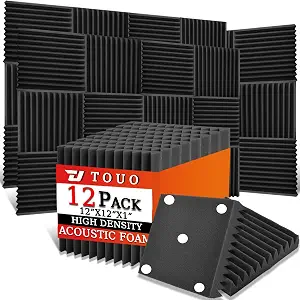 | Best for Small, Targeted Areas | Quantity: 12 panels | Panel dimensions: 12 x 12 x 1 inches | Material: Polyurethane foam | VIEW ON AMAZON | See Our Full Breakdown |
| Focusound 52-Pack Acoustic Foam Panels, 1″ x 12″ x 12″, with 300 Double-Sided Adhesive Pieces |  | Best for Studio-Scale Coverage | Quantity: 52 panels | Panel dimensions: 12 x 12 inches | Panel thickness: 1 inch | VIEW ON AMAZON | See Our Full Breakdown |
| Knightsacoustic 96-Pack Acoustic Foam Panels, 1 x 12 x 12 Inches, Black |  | Best for Maximum Panel Count | Quantity: 96 panels | Panel dimensions: 1 x 12 x 12 inches | Color: Black | VIEW ON AMAZON | See Our Full Breakdown |
| UMIACOUSTICS 2 PCS Acoustic Panel, 47.2″ x 23.6″ Fiberglass Sound Proof Wall Panels, Charcoal Grey |  | Best for Large-Wall Coverage | Quantity: 2 panels | Panel dimensions: 47.2 × 23.6 × 2 inches | Core material: Fiberglass | VIEW ON AMAZON | See Our Full Breakdown |
| 12 Pack Acoustic Foam Panels 2″ x 12″ x 12″, Black |  | Best for Thick Foam Tile Treatment | Quantity: 12 panels | Panel dimensions: 12 × 12 × 2 inches | Shape: Wedge | VIEW ON AMAZON | See Our Full Breakdown |
| TONOR Wood Slatwall Panels, 4 Pack, 47.2″ x 23.6″, Walnut |  | Best Decorative Acoustic Wall Treatment | Quantity: 4 panels | Panel dimensions: 47.2 × 23.6 inches (120 × 60 cm) | Coverage: 31 square feet | VIEW ON AMAZON | See Our Full Breakdown |
| Saiqiang Acoustic Foam Panels, 12-Pack, 1 × 12 × 12 Inches, Black Wedge |  | Best for Simple, Lightweight Treatment | Brand: Saiqiang | Quantity: 12 panels | Panel dimensions: 12 × 12 × 1 inch | VIEW ON AMAZON | See Our Full Breakdown |
| Ekkogo Acoustic Wall Panels, 12-Pack, White Square, 12 × 12 × 0.4 in |  | Best for a Clean, Low-Profile Finish | Quantity: 12 panels | Panel dimensions: 12 × 12 inches | Thickness: 0.4 inches | VIEW ON AMAZON | See Our Full Breakdown |
| NeatiEase Teak Wood Slat Wall Panels, 4-Piece Set |  | Best Decorative Wood-Slat Pick | Brand: NeatiEase | Quantity: 4 panels | Panel dimensions: 96 × 12.6 in each | VIEW ON AMAZON | See Our Full Breakdown |
| Knightsacoustic Acoustic Foam Panels, 50 Pack, 12 × 12 × 2 Inches, Black |  | Best for Broad Foam Coverage | Brand: Knightsacoustic | Quantity: 50 panels | Panel dimensions: 12 × 12 × 2 inches | VIEW ON AMAZON | See Our Full Breakdown |
| 2” Thick Acoustic Panels with Hanging Hardware, 2 PCS 47.2” x 23.6” Fiberglass Sound Absorbing Panels for Home Theater, Office, and More |  | Best for Targeted, High-Absorption Treatment | Quantity: 2 panels | Dimensions: 47.2 × 23.6 in each | Thickness: 2 inches | VIEW ON AMAZON | See Our Full Breakdown |
| Lagom Sound Absorbing Panels 23.6 x 23.6 Inches, 6 Pack |  | Best for Simple Peel-and-Stick Installation | Panel dimensions: 23.62 × 23.62 in | Total coverage: 72 × 48 in | Quantity: 6 panels | VIEW ON AMAZON | See Our Full Breakdown |
| 24-Pack 2-Inch Thick Pyramid Acoustic Foam Panels |  | Best Flame-Retardant Foam Option | Pack size: 24 panels | Thickness: 2 inches | Design: Pyramid | VIEW ON AMAZON | See Our Full Breakdown |
| soundproofing panel | Panel dimensions | Quantity | Color | Material |
|---|---|---|---|---|
| TEMGCUAM 54-Pack Acoustic Foam | 12 x 12 x 1 inches | — | Black | High-density polyurethane foam |
| NEPIS Self-Adhesive Acoustic F | 11.8 × 11.8 × 0.36 inches | 20 panels | Black | Polyester |
| TOUO 12-Pack Acoustic Foam Pan | 12 x 12 x 1 inches | 12 panels | Black | Polyurethane foam |
| Focusound 52-Pack Acoustic Foa | 12 x 12 inches | 52 panels | — | — |
| Knightsacoustic 96-Pack Acoust | 1 x 12 x 12 inches | 96 panels | Black | High-density acoustic foam |
| UMIACOUSTICS 2 PCS Acoustic Pa | 47.2 × 23.6 × 2 inches | 2 panels | Charcoal grey | — |
| 12 Pack Acoustic Foam Panels 2 | 12 × 12 × 2 inches | 12 panels | Black | Polyurethane foam |
| TONOR Wood Slatwall Panels | 47.2 × 23.6 inches (120 × 60 cm) | 4 panels | — | — |
| Saiqiang Acoustic Foam Panels | 12 × 12 × 1 inch | 12 panels | Black | High-density foam |
| Ekkogo Acoustic Wall Panels | 12 × 12 inches | 12 panels | White | Polyester |
| NeatiEase Teak Wood Slat Wall | 96 × 12.6 in each | 4 panels | Teak | — |
| Knightsacoustic Acoustic Foam | 12 × 12 × 2 inches | 50 panels | Black | Acoustic foam |
| 2” Thick Acoustic Panels with | — | 2 panels | Heather Grey | 100% polyester fabric wrap with fiberglass core |
| Lagom Sound Absorbing Panels 2 | 23.62 × 23.62 in | 6 panels | — | — |
| 24-Pack 2-Inch Thick Pyramid A | — | — | — | Flame-retardant acoustic foam |
More Details on Our Top Picks
TEMGCUAM 54-Pack Acoustic Foam Wall Panels, 12 x 12 x 1 in
For buyers treating a larger room with basic foam, the 54-panel count and included 270 adhesive pads make this a balanced starting point. Each 12-inch square is one inch thick, so the wedge-patterned polyurethane can help tame reflections and reverberation across walls; it is not a substitute for sound-blocking construction when noise is coming through a wall. Compared with the 12-pack TOUO panels, TEMGCUAM covers more area in one purchase, while the Focusound 52-pack offers a similar panel count and more adhesive pieces. The tradeoff is that its pads are intended for clean, dry, smooth surfaces, so textured or dusty walls may call for another mounting approach. I’d choose it for practical coverage, not for the thickest treatment or a polished decor finish.
Pros:- 54 one-inch panels cover more area than the 12-panel TOUO set.
- Wedge surfaces are designed to reduce room echo and reverberation.
- Includes 270 adhesive pads for mounting on suitable surfaces.
- Lightweight polyurethane foam is intended for studios, gaming rooms, and offices.
Cons:- One-inch foam absorbs reflections but does not provide meaningful sound isolation through a wall.
- Adhesive pads may not hold reliably on textured or otherwise unsuitable surfaces.
- The black foam look may not suit buyers seeking a decorative wall treatment.
Best for: Home studio, gaming-room, or office owners who want to treat a broader wall area with one-inch foam and supplied mounting pads.
Not ideal for: Buyers trying to stop sound passing through walls, or anyone mounting panels on rough, damp, or dusty surfaces without a separate fastening plan.
- Pack size:54 panels
- Panel dimensions:12 x 12 x 1 inches
- Material:High-density polyurethane foam
- Color:Black
- Included accessories:270 adhesive pads
- Item weight:4.93 pounds
Our verdict“Choose TEMGCUAM for a broad, straightforward foam treatment when echo control matters more than blocking sound or matching room decor.”
NEPIS Self-Adhesive Acoustic Foam Panels, 20-Pack, Black
NEPIS takes a different approach from the one-inch TEMGCUAM and TOUO foam: its 20 polyester panels are just 0.36 inches thick, with self-adhesive backing and a stated coverage of about 20 square feet. That slim profile is useful where bulky foam would be unwelcome, and the brick-style 3D surface gives the wall a more finished pattern than conventional wedge foam. The tradeoff is limited depth; buyers wanting fuller absorption across a room may prefer the thicker Focusound or TEMGCUAM panels, though those require more wall clearance. NEPIS is described as odorless and non-toxic, and the listing gives a noise reduction coefficient over 0.95, but that figure should not be read as proof of blocking sound through walls. I’d pick this for light echo control and simple placement, not heavy acoustic treatment.
Pros:- Self-adhesive backing simplifies mounting compared with separate-pad foam sets.
- Twenty panels cover about 20 square feet.
- Slim 0.36-inch profile takes up less wall depth than TEMGCUAM or Focusound foam.
- Polyester material is described as odorless and non-toxic.
Cons:- At 0.36 inches thick, it offers less material depth than the one-inch foam options.
- A 20-panel set may not cover enough area for larger rooms.
- Echo reduction depends on panel placement and coverage; the panels do not block sound transmission.
Best for: Renters or home-office users who want a slim, self-adhesive panel for a modest echo-control area without the bulk of one-inch foam.
Not ideal for: Buyers seeking thicker absorption, extensive room treatment, or panels that will stop neighboring-room noise from passing through a wall.
- Quantity:20 panels
- Panel dimensions:11.8 × 11.8 × 0.36 inches
- Coverage:About 20 square feet
- Material:Polyester
- Color:Black
- Installation:Self-adhesive backing
- Noise reduction coefficient:Over 0.95, as listed
- Material density:Up to 14.35 lb/ft³
Our verdict“Choose NEPIS for slim, convenient coverage on a limited wall area, but pick thicker foam if room reflections are the bigger problem.”
TOUO 12-Pack Acoustic Foam Panels, 12 x 12 x 1 Inch, Black
The TOUO set suits buyers who need to treat a small, specific reflection area rather than cover a whole room. Its 12 one-inch polyurethane squares are the same size and thickness as the TEMGCUAM panels, but the smaller pack means less material to place around a desk, vocal position, or compact recording setup. It includes 60 pieces of double-sided adhesive tape and can be cut to fit, adding flexibility that the larger pre-counted sets may not offer. The product description also says the foam self-extinguishes within one minute; that claim does not remove the need to follow safe installation and room-use practices. Compared with the 52-panel Focusound set, TOUO is easier to limit to a focused treatment but offers far less coverage. Compressed foam may take up to 48 hours to expand, so it is not an instant-install choice.
Pros:- One-inch panels provide more thickness than the slim NEPIS option.
- Includes 60 pieces of double-sided adhesive tape.
- Panels can be cut to fit around specific areas.
- Product description states the foam self-extinguishes within one minute.
Cons:- Twelve panels provide limited coverage for larger rooms.
- Vacuum-packed foam may need up to 48 hours to expand.
- Absorbs room reflections rather than blocking noise through walls.
Best for: Podcasters, gamers, or home-office users treating a compact desk or microphone area who want a small set that can be trimmed to fit.
Not ideal for: Anyone covering several walls or seeking substantial room-wide treatment; the 12-panel count is much smaller than the TEMGCUAM and Focusound sets.
- Quantity:12 panels
- Panel dimensions:12 x 12 x 1 inches
- Material:Polyurethane foam
- Color:Black
- Weight:14.9 ounces
- Included accessories:60 pieces of double-sided adhesive tape
- Flame resistance:Product description states self-extinguishes within 1 minute
- Model:02(25)SJC-Black012
Our verdict“Choose TOUO for a compact, customizable echo-control patch, not for broad room coverage or sound isolation.”
Focusound 52-Pack Acoustic Foam Panels, 1″ x 12″ x 12″, with 300 Double-Sided Adhesive Pieces
Focusound is the more coverage-focused choice for buyers treating a home studio, vocal booth, or control room: the set supplies 52 one-inch panels and 300 adhesive pieces. That is close to the TEMGCUAM pack’s panel count, with more mounting pieces listed, though both rely on adhesive rather than a permanent framed installation. Its triangular-groove foam is intended to reduce echo and reverb, making it a better fit for room acoustics than for blocking voices or music from passing through a wall. Compared with the 12-panel TOUO set, Focusound is far better suited to spreading treatment across a larger area; compared with NEPIS, it has substantially more thickness but takes up more space and has a more utilitarian foam appearance. The option to reshape compressed panels with water adds a recovery method, but drying takes 24 to 48 hours.
Pros:- 52 panels offer much broader coverage than the TOUO 12-pack.
- One-inch thickness gives it more depth than the NEPIS panels.
- Includes 300 pieces of double-sided adhesive.
- Suitable for home offices, recording studios, vocal booths, and control rooms.
Cons:- Foam absorbs reflections but does not block sound transmission through walls.
- Compressed panels may need soaking and 24 to 48 hours of air-drying to recover their shape.
- The large foam set requires substantial wall area and careful placement.
Best for: Home-studio owners, vocalists, and office users who need many one-inch foam panels and included adhesive pieces for a broader treatment area.
Not ideal for: Buyers who need a slim decorative panel, a permanent sound-isolating barrier, or a treatment they can install without allowing time for foam recovery if compressed.
- Quantity:52 panels
- Panel dimensions:12 x 12 inches
- Panel thickness:1 inch
- Adhesive included:300 pieces of double-sided adhesive
- Panel design:Triangular-groove acoustic foam
- Model:FS0302F
- Recommended uses:Home offices, recording studios, vocal booths, and control rooms
Our verdict“Choose Focusound when you need a large, adhesive-ready foam treatment for a studio or vocal space and can allow time for panel recovery.”
Knightsacoustic 96-Pack Acoustic Foam Panels, 1 x 12 x 12 Inches, Black
With 96 one-inch panels, Knightsacoustic offers the highest count in this group, making it the clearest fit for buyers planning to cover a wide area or keep spare panels for later placement. The foam is intended to reduce echoes and background noise inside studios, recording booths, theaters, and game rooms; like the TEMGCUAM and Focusound sets, it should be treated as sound absorption, not soundproofing between rooms. Its main compromise is setup: unlike those two alternatives, this pack includes no adhesive, so buyers must source suitable mounting materials and account for their wall surface. Compressed panels may also need ventilation or water treatment to regain their shape. I’d choose it for quantity over convenience, while buyers who want mounting supplies in the box are better served by TEMGCUAM or Focusound.
Pros:- The 96-panel count is higher than the other foam sets in this batch.
- One-inch panels are intended to absorb reflections and reduce room echo.
- Suitable for studios, recording booths, theaters, and game rooms.
- Product description characterizes the foam as low-odor and non-toxic.
Cons:- Adhesive is not included, unlike the TEMGCUAM and Focusound sets.
- Compressed panels may need ventilation or water treatment to recover their shape.
- Foam treatment does not provide sound isolation through walls.
Best for: Studio, theater, or gaming-room owners covering a large wall area who already have a suitable mounting method or plan to buy one.
Not ideal for: First-time installers who want adhesive included, or anyone expecting foam panels to stop sound from traveling between rooms.
- Quantity:96 panels
- Panel dimensions:1 x 12 x 12 inches
- Color:Black
- Material:High-density acoustic foam
- Adhesive included:No
- Unit count:96
- Recommended uses:Studios, recording booths, theaters, and game rooms
Our verdict“Choose Knightsacoustic for the largest panel count when you can supply your own mounting solution and want interior echo control.”
UMIACOUSTICS 2 PCS Acoustic Panel, 47.2″ x 23.6″ Fiberglass Sound Proof Wall Panels, Charcoal Grey
For buyers who want to treat a broad section of wall without arranging many small tiles, I’d shortlist the UMIACOUSTICS two-panel set. Each fiberglass panel measures 47.2 by 23.6 inches and is 2 inches thick, so the pair offers a larger, more continuous treatment area than the 12-inch foam squares from Saiqiang or the 12-pack foam option. The listed NRC of 0.95 points to strong sound absorption for reducing room reflections and echo; it does not mean the panels block sound passing through walls. Included hanging hardware also suits renters or studio owners who prefer mounting rather than adhesive. The tradeoff is that these are larger, heavier-looking wall pieces that need suitable mounting space, and the listing gives less installation flexibility than cuttable tile panels.
Pros:- Two large panels cover more wall area per piece than the Saiqiang foam squares.
- Two-inch fiberglass construction is suited to absorbing room reflections.
- Hanging hardware is included for wall mounting.
- Listed NRC is 0.95.
Cons:- Absorbs reflections but is not a substitute for structural sound isolation.
- Large panels offer less flexibility for fitting around obstacles than small tiles.
- The listing does not specify total coverage area or panel weight.
Best for: Home-studio and home-theater owners who want broad wall coverage with mounted, 2-inch fiberglass panels.
Not ideal for: People trying to stop sound from traveling between rooms, or those who need small pieces for narrow or irregular spaces.
- Quantity:2 panels
- Panel dimensions:47.2 × 23.6 × 2 inches
- Core material:Fiberglass
- Cover material:100% polyester high-density fabric
- Noise Reduction Coefficient:0.95
- Color:Charcoal grey
- Installation:Hanging hardware included
Our verdict“Choose this set for broad, mounted wall treatment in a studio or theater, not for blocking noise between rooms.”
12 Pack Acoustic Foam Panels 2″ x 12″ x 12″, Black
This 12-pack suits buyers who want 2-inch-thick foam tiles in a smaller, modular format. Compared with Saiqiang’s 1-inch wedge panels, the added thickness gives this set a more substantial absorber for managing reflections in a home studio, office, or theater. The square shape makes it easier to arrange a defined patch than a pair of large wall panels such as UMIACOUSTICS, while the supplied double-sided tape keeps installation straightforward. The material is described as fire-resistant polyurethane, but that does not make the panels sound barriers: they are intended to manage room sound, not prevent noise from passing through a wall. Buyers should also plan for a wait after unpacking, since the foam may need 24–48 hours to expand, and some pieces may need help fluffing up.
Pros:- Two-inch thickness gives more depth than Saiqiang’s 1-inch foam tiles.
- Twelve square panels can be arranged to suit a smaller treatment area.
- Double-sided tape is supplied for installation.
- Polyurethane material is described as fire-resistant.
Cons:- The 12-panel pack covers a limited area compared with larger multipacks.
- Panels may take 24–48 hours to expand fully after unpacking.
- Some panels may need additional fluffing, and the only listed color is black.
Best for: Home-recording and gaming-room owners who want thicker, modular foam tiles and a tape-based installation.
Not ideal for: Buyers seeking decorative wood finishes, large continuous panels, or sound isolation between rooms.
- Quantity:12 panels
- Panel dimensions:12 × 12 × 2 inches
- Shape:Wedge
- Material:Polyurethane foam
- Color:Black
- Fire resistance:Yes
- Installation:Double-sided adhesive
- Expansion time:24–48 hours
Our verdict“Pick this set for a compact area where thicker foam and simple tape mounting matter more than broad coverage or room-to-room isolation.”
TONOR Wood Slatwall Panels, 4 Pack, 47.2″ x 23.6″, Walnut
If visible foam would clash with your room, TONOR offers a more furniture-like approach: walnut-finish slats over a polyester-fiber and MDF structure. The four panels cover a stated 31 square feet, making this a better choice for a coordinated feature wall than the small black tiles from Saiqiang or the white Ekkogo squares. The product description presents the layered construction as sound damping, while the slat design also adds a warm architectural finish. Installation can use screws or adhesive, and the panels can be cut for custom layouts. That flexibility comes with more planning and wall work than sticking up foam tiles, and the listing does not provide an NRC figure to compare directly with UMIACOUSTICS or Ekkogo. I’d choose these when decor matters alongside room acoustics, not when a quantified absorption rating is the priority.
Pros:- Four panels provide a stated 31 square feet of coverage.
- Walnut veneer and slat styling create a finished decor feature unlike exposed foam.
- Can be installed with screws or adhesive.
- Panels can be cut to fit custom layouts.
Cons:- No NRC or other quantified absorption rating is provided.
- Cutting and mounting require more planning than installing the Saiqiang foam tiles.
- Adhesive or screw installation may not suit every wall or rental situation.
Best for: Homeowners and office designers treating a broad feature wall who want a walnut wood look as well as sound damping.
Not ideal for: Recording-room buyers prioritizing stated acoustic ratings, or renters who cannot screw or adhere panels to walls.
- Quantity:4 panels
- Panel dimensions:47.2 × 23.6 inches (120 × 60 cm)
- Coverage:31 square feet
- Construction:High-density polyester fiber, MDF, and solid wood veneer
- Finish:Walnut
- Installation:Adhesive or screws
- Customization:Can be cut to size
Our verdict“Choose TONOR for a large, decorative feature wall with acoustic damping, but favor rated absorbers when measured performance is your main criterion.”
Saiqiang Acoustic Foam Panels, 12-Pack, 1 × 12 × 12 Inches, Black Wedge
Saiqiang is the straightforward pick for buyers who need a modest patch of lightweight, 1-inch foam to tame reflections. Its 12 wedge panels are easier to place around a desk or recording corner than the large UMIACOUSTICS fiberglass panels, and the included nano tape offers a simpler route than TONOR’s screw-or-adhesive mounting. The tradeoff is thickness: this set is half as thick as the other 12-pack foam option in this roundup, so it is the more basic choice for managing echo rather than a broad, heavy-duty treatment. Its fire-resistant claim and two-year warranty add practical reassurance, but neither changes the central limitation: acoustic foam does not structurally soundproof a room. Allow 24–48 hours for expansion before judging the final fit and appearance.
Pros:- Lightweight 12-inch squares are easier to position than large fiberglass panels.
- Nano double-sided tape is included, with construction adhesive as another option.
- Wedge texture is intended to manage sound reflections and echo.
- Fire-resistant material and a two-year warranty are specified.
Cons:- One-inch thickness is less substantial than the 2-inch foam tile set.
- Twelve panels provide limited coverage for larger rooms.
- Requires 24–48 hours to expand after unpacking and does not provide structural sound isolation.
Best for: Beginners treating a desk-side recording, gaming, or video-call area who want light panels and simple mounting.
Not ideal for: Buyers needing thicker foam, wide wall coverage, or a solution that blocks sound transfer between rooms.
- Brand:Saiqiang
- Quantity:12 panels
- Panel dimensions:12 × 12 × 1 inch
- Shape:Wedge
- Material:High-density foam
- Color:Black
- Installation:Construction adhesive or included nano double-sided tape
- Expansion time:24–48 hours
- Warranty:2 years
Our verdict“Choose Saiqiang for a small, easy-to-mount echo-control project, and choose thicker or larger panels for more extensive wall treatment.”
Ekkogo Acoustic Wall Panels, 12-Pack, White Square, 12 × 12 × 0.4 in
Ekkogo is the visually restrained option for buyers who want white, low-profile wall tiles rather than black foam. Each 12-inch polyester panel is only 0.4 inches thick, so it takes up less visual and physical space than Saiqiang’s 1-inch wedges or the 2-inch foam tiles. The listed NRC of up to 0.95 is a useful specification, but actual room results depend on placement and coverage; the product’s stated one-square-foot coverage per panel also means this 12-pack treats only a small area. Beveled edges and cuttable material help create a neater layout, while recycled content and formaldehyde-free construction may appeal to material-conscious buyers. Unlike the foam packs, adhesive is not included, adding a separate installation step.
Pros:- White finish and beveled edges create a subtler look than black foam tiles.
- Thin 0.4-inch panels suit spaces where thicker panels would feel intrusive.
- Panels can be cut to fit a layout.
- Made with recycled materials and described as formaldehyde-free and flame-retardant.
Cons:- The 12-panel set covers only 12 square feet based on the stated one-square-foot coverage per panel.
- Adhesive is not included, unlike the tape-equipped Saiqiang and 2-inch foam sets.
- Its low-profile thickness offers less depth than the thicker foam and fiberglass options.
Best for: People treating a small, bright-colored office or living-space wall who want thin polyester tiles and a tidy appearance.
Not ideal for: Buyers seeking substantial wall coverage, thicker absorbers, or an installation kit with adhesive included.
- Quantity:12 panels
- Panel dimensions:12 × 12 inches
- Thickness:0.4 inches
- Coverage:1 square foot per panel
- Material:Polyester
- Density:5.9 oz/ft² (1800 g/m²)
- Noise Reduction Coefficient:Up to 0.95
- Color:White
- Installation:Adhesive not included
Our verdict“Pick Ekkogo for a neat, white, low-profile treatment on a small wall, but choose thicker panels for deeper treatment or a larger area.”
NeatiEase Teak Wood Slat Wall Panels, 4-Piece Set
For buyers who want echo control without a foam-panel look, NeatiEase pairs a teak-finish slat surface with a high-density polyester fiber backing. Its four long panels cover about 33 square feet, making them a better fit for a feature wall or ceiling section than small, scattered treatment. Compared with the Lagom Sound Absorbing Panels, this set offers a wood-style finish and longer pieces, but it takes more planning to cut and mount; Lagom’s peel-and-stick format is simpler for a quick installation. NeatiEase can be mounted horizontally or vertically with screws or adhesive, though neither option is included as a complete mounting kit. It is intended for indoor use, and the lack of a warranty is a drawback for a substantial wall installation. Like other absorbers here, it helps tame reflections rather than block noise through walls.
Pros:- Wood-slat appearance suits a finished interior better than exposed acoustic foam.
- About 33 square feet of coverage from four long panels.
- Can be cut to shape and installed horizontally or vertically.
- MDF and high-density polyester fiber construction is designed to absorb sound and reduce echo.
Cons:- Mounting screws or adhesive are required, and installation takes more planning than peel-and-stick panels.
- Indoor use only, so it is not suited to outdoor or damp installations.
- No warranty is provided.
Best for: Homeowners furnishing a living room, office, or media room who want a teak-look feature wall that can also help reduce echo.
Not ideal for: Renters seeking a removable treatment, buyers needing a small ready-to-place kit, or anyone trying to block noise from an adjoining room.
- Brand:NeatiEase
- Quantity:4 panels
- Panel dimensions:96 × 12.6 in each
- Coverage:About 33 sq. ft.
- Materials:MDF and high-density polyester fiber
- Color:Teak
- Weight:19.96 kg
- Installation:Screws or superglue; walls or ceilings
- Warranty:None
Our verdict“Choose NeatiEase if you want broad, decorative indoor coverage and can handle a more involved mounting job.”
Knightsacoustic Acoustic Foam Panels, 50 Pack, 12 × 12 × 2 Inches, Black
The main advantage here is a 50-panel quantity with 2-inch thickness, suited to covering more of a room than a small set of rigid panels. Knightsacoustic is aimed at studios, recording booths, theaters, and game rooms where reducing reflections and background noise inside the space matters. Its foam is designed to regain shape after compression, which is useful when panels arrive compressed or need temporary handling. Compared with the 24-Pack 2-Inch Thick Pyramid Acoustic Foam Panels, this set provides more square panels, while the pyramid option has a shaped face and specifically states flame-retardant construction. Knightsacoustic requires buyers to source adhesive separately, and it absorbs sound rather than blocking sound passing through a wall. That distinction matters: it can help recordings sound less echoey, but it is not a substitute for sound isolation.
Pros:- 50 panels provide a larger treatment quantity than the 24-panel pyramid foam set.
- Two-inch thickness is designed for sound absorption and echo reduction.
- Foam is designed to recover its shape after compression.
- Described as low-odor and non-toxic.
Cons:- Adhesive is not included, adding a separate installation step and supply choice.
- Absorbs sound within a room but does not block sound transmission through walls.
- Black foam has a utilitarian appearance compared with the wood-look NeatiEase panels.
Best for: Home-studio owners or game-room users who want a substantial quantity of 2-inch foam for reducing room reflections.
Not ideal for: People seeking noise isolation from neighbors, buyers who want included adhesive, or anyone prioritizing a finished decorative wall surface.
- Brand:Knightsacoustic
- Quantity:50 panels
- Panel dimensions:12 × 12 × 2 inches
- Color:Black
- Material:Acoustic foam
- Adhesive included:No
- Intended effect:Absorbs sound to reduce echoes and background noise
- Shape recovery:Designed to regain shape after compression
Our verdict“Pick this set for broad, practical foam treatment when you can supply the adhesive and do not expect sound blocking.”
2” Thick Acoustic Panels with Hanging Hardware, 2 PCS 47.2” x 23.6” Fiberglass Sound Absorbing Panels for Home Theater, Office, and More
These two large panels suit buyers who want substantial sound absorption in a defined area, rather than a large quantity of small foam tiles. The stated NRC is above 0.95, and the 2-inch fiberglass core is intended to reduce reverberation in spaces such as theaters, offices, and studios. Included hanging hardware gives this set a more complete mounting route than the Knightsacoustic Acoustic Foam Panels, which require separate adhesive, though these panels still are not self-adhesive. Their 47.2-by-23.6-inch format can create a cleaner, less fragmented wall treatment, but two pieces cover a limited area compared with NeatiEase’s roughly 33 square feet. The product data also cautions against ceiling mounting without proper support. These panels absorb reflections; they should not be treated as a barrier to outside noise.
Pros:- Two-inch fiberglass panels are designed for strong sound absorption, with stated NRC greater than 0.95.
- Large dimensions create broader, less tiled-looking coverage than small foam squares.
- Hanging hardware is included.
- Fabric-wrapped finish is suited to visible indoor spaces such as offices and theaters.
Cons:- Only two panels are included, limiting total treated area.
- Not self-adhesive, so installation requires hardware and a suitable mounting surface.
- Ceiling mounting may require added support.
Best for: Studio, office, or home-theater owners who want a pair of large, hanging panels for a focused echo-control area.
Not ideal for: Buyers needing wall-to-wall coverage, peel-and-stick installation, or ceiling placement without a secure support plan.
- Quantity:2 panels
- Dimensions:47.2 × 23.6 in each
- Thickness:2 inches
- Material:100% polyester fabric wrap with fiberglass core
- Color:Heather Grey
- Installation:Hanging hardware included; not self-adhesive
- NRC:Greater than 0.95
Our verdict“Choose this pair for focused, high-absorption wall treatment when you prefer large hanging panels over foam tiles.”
Lagom Sound Absorbing Panels 23.6 x 23.6 Inches, 6 Pack
Lagom is the most straightforward choice in this group for buyers who want a decorative panel treatment without separate mounting hardware. Six 23.62-inch squares use peel-and-stick application, making placement less involved than the hanging fiberglass panels or the screw-or-adhesive NeatiEase slats. The linear pattern also looks more finished than exposed acoustic foam. Its listed total coverage is 72 by 48 inches, so this is a modest treatment area rather than a whole-room solution; larger rooms may need several sets. Compared with the 24-Pack 2-Inch Thick Pyramid Acoustic Foam Panels, Lagom prioritizes appearance and convenience over a large count of shaped foam pieces. Adhesive quality may vary, and the product data gives no material or thickness details to help buyers compare absorption performance precisely. It helps reduce reflected sound and echoes, not noise passing through walls.
Pros:- Peel-and-stick installation avoids separate hanging hardware.
- Linear pattern offers a more decorative finish than basic foam panels.
- Six square panels are suited to targeted wall treatment.
- Designed to absorb reflected sound and reduce echoes.
Cons:- Listed coverage is limited for larger rooms and may require multiple sets.
- Adhesive quality may vary.
- Limited color options and few material or performance details are provided.
Best for: Renters or home-office users who want a small, patterned wall treatment with peel-and-stick application and minimal installation work.
Not ideal for: Buyers covering a large room, those who need documented absorption specifications, or anyone seeking sound isolation from adjacent spaces.
- Panel dimensions:23.62 × 23.62 in
- Total coverage:72 × 48 in
- Quantity:6 panels
- Installation:Peel-and-stick
- Design:Modern linear pattern
- Intended effect:Absorbs reflected sound and reduces echoes
Our verdict“Choose Lagom for an easy, decorative echo-reduction project over a small area, not for whole-room treatment or sound isolation.”
24-Pack 2-Inch Thick Pyramid Acoustic Foam Panels
This set is a practical match for buyers who want 2-inch pyramid foam with flame-retardant material for a studio, office, gaming setup, or home theater. Its lightweight panels can go on walls or ceilings, giving it more placement flexibility than the large fiberglass panels, which caution against ceiling installation without proper support. Compared with the Knightsacoustic Acoustic Foam Panels, this pack has fewer panels but a pyramid surface and an explicit flame-retardant specification. Neither option includes adhesive, so installation supplies are a separate task. The panels are designed to absorb echo and reverberation, not block outside noise or isolate a room; buyers dealing with traffic or sound from neighbors will need a different kind of sound-control approach. A 24-piece pack may also leave larger rooms only partly treated, depending on how much surface coverage is desired.
Pros:- Two-inch pyramid foam is designed to reduce echo and reverberation.
- Lightweight construction supports wall or ceiling placement.
- Flame-retardant material is specified.
- Suitable for studios, offices, gaming setups, and home theaters.
Cons:- Does not block external noise or provide noise isolation.
- Construction adhesive or double-sided tape is not included.
- A 24-panel pack may not provide enough coverage for a larger room.
Best for: Home-studio and gaming-room owners seeking lightweight, 2-inch foam panels with a pyramid face and stated flame-retardant material.
Not ideal for: People trying to stop noise from entering or leaving a room, buyers who need adhesive included, or those treating a large space with a single pack.
- Pack size:24 panels
- Thickness:2 inches
- Design:Pyramid
- Material:Flame-retardant acoustic foam
- Installation:Construction adhesive or double-sided tape; not included
- Placement:Walls or ceilings
- Intended use:Sound absorption; not for soundproofing or noise isolation
Our verdict“Pick this set for lightweight, flame-retardant pyramid foam treatment when echo reduction—not blocking noise—is the goal.”

How We Picked
I compared the 15 listed options by sound-absorption format, thickness, panel size, and stated coverage, then weighed those features against installation demands, finish, and likely room use. Larger fiberglass panels, thin foam squares, two-inch foam, and wood-slat designs serve different needs, so I did not rank them as interchangeable products or equate more pieces with better performance. I also favored clear, useful distinctions—such as panel depth, mounting approach, and appearance—over broad claims about “soundproofing.”
The ranking gives priority to useful acoustic surface area and a practical balance of performance and versatility, with ease of installation and room appearance shaping the category picks. Bulk one-inch foam sets can cover many spots at once, but their modest thickness limits their role; thicker foam and fiberglass have more substance, while wood slats offer a more decor-friendly finish. Since the supplied product details do not establish independent test results, fire ratings, or sound-isolation figures, I avoid claiming measured performance and recommend checking those specifications before purchase.
Factors to Consider When Choosing Soundproofing Panels
Choosing among soundproofing panels starts with identifying the sound problem, not choosing a color or pack size. The following factors help separate echo control from actual noise blocking and can prevent buying panels that do not match the room.
1. Decide Whether You Need Echo Control or Sound Isolation
Acoustic panels are generally intended to absorb reflections within a room, which can make speech and recordings sound less reverberant. They usually do not stop a neighbor’s voice or traffic from passing through a wall by themselves. For sound traveling between rooms, gaps around doors, thin walls, and shared ceilings may matter more than untreated reflections. Start by listening for whether the problem is echo after a sound occurs or noise entering from elsewhere. If the goal is isolation, look into sealing leaks, adding wall mass, and addressing structural paths before covering the surface with foam.
2. Compare Thickness and Material, Not Just Pack Count
A high tile count can make a set look like a better coverage deal, but each tile may be thin or small. One-inch foam squares and two-inch panels are not equivalent, and fiberglass panels bring a different construction from foam. Thicker absorbers can be more useful for a broader range of reflections, though material, placement, and air space behind a panel also affect results. Check the dimensions and total area rather than relying on the number of pieces in the box. Avoid assuming that a pyramid or wedge surface alone makes a panel more effective than a thicker, flatter alternative.
3. Plan Coverage Around the Room’s Sound Paths
Covering every wall is rarely the best first move for a typical home studio or office. Begin with the surfaces that create strong early reflections, often the side walls near a listening or recording position, then reassess the room. A small number of larger panels can be easier to place precisely, while many small tiles let you spread treatment across irregular areas. Measure the intended zones before ordering, including space around outlets, windows, and furniture. Over-treating a room with thin foam can change the high-frequency character without solving low-frequency buildup or outside noise.
4. Match Mounting to the Wall and Your Plans
Self-adhesive panels may be convenient, but adhesives can pull paint or fail on dusty, textured, or damp surfaces. Check the product’s mounting instructions and test a discreet area if the wall finish matters. Mechanical hardware or removable hanging methods can be a better fit for renters or heavier panels, though they may take more setup. Count the cost of mounting supplies and installation time as part of the decision, especially for large tile packs. A panel that is easy to reposition can be more useful than one that is quick to stick down but difficult to remove cleanly.
5. Weigh Room Appearance, Safety, and Maintenance
Foam is often chosen for studios and utility spaces, while wood-slat and fabric-style panels may blend more naturally into shared living areas. Decorative finishes can make treatment easier to keep visible, but style does not prove acoustic performance; check what material sits behind the surface. Review fire-safety information and any care guidance before placing panels near heat sources or in busy rooms. Consider whether the surface can be dusted or cleaned, since textured foam can collect dust and may be awkward to wipe. Paying more for a finished panel makes sense when appearance and durability matter, but not if the actual need is simply to reduce a specific echo.
6. Set a Realistic Budget for the Whole Treatment
Panel cost is only one part of a room treatment plan: mounting hardware, extra coverage, and possible wall repair can add effort and expense. A large bulk pack may be economical per piece but still leave you with more panels than the room needs. Conversely, a small premium set may look polished but cover only a limited area. Decide which wall zones need treatment, then compare the price-independent value of coverage, thickness, material, and finish. If you are unsure, treat one area first and listen again before committing to a full-room layout.
Frequently Asked Questions
Will these panels stop sound from reaching the next room?
Most options in this lineup are designed to absorb sound reflections inside the room, not block transmission through a wall. Foam tiles may make a room sound less echoey without doing much to reduce voices heard on the other side. Sound isolation usually calls for sealing air gaps and improving the wall, door, or ceiling assembly. If the noise enters through a window or door, treating an unrelated wall with panels is unlikely to solve the main problem. Choose panels for room acoustics, and handle sound leakage as a separate project.
Should I choose one-inch foam or two-inch panels?
One-inch foam can suit light echo control or a limited budget, especially when spread across several reflection points. Two-inch options provide more depth, but thickness alone does not tell the whole performance story; material, coverage, and placement still matter. A pack with more thin tiles may cover more wall than a smaller thick-panel set, while the thicker set may be a better match for more substantial treatment. Compare total panel area and installation plans, not just the thickness printed in the name. If low-frequency sound is the main issue, neither thickness should be assumed to solve it without suitable room treatment.
Are adhesive panels a good choice for a rental?
They can be convenient, but adhesive may damage paint or leave residue when removed, and performance depends on the wall surface. Check the mounting details and removal guidance before applying panels across a large area. A small test patch in a hidden spot can reveal whether the adhesive is compatible with the finish. For a rental, removable hooks, rails, or other non-permanent mounting may be safer, particularly for larger panels. Include mounting compatibility in the decision rather than treating self-adhesive backing as a guaranteed renter-friendly feature.
How much wall area should I cover to reduce echo?
There is no single coverage percentage that works for every room, since furnishings, room shape, and sound source all affect reflections. Start by identifying the listening or recording position and treating the nearest strong reflection points rather than covering walls at random. A small test area can help you judge whether the room’s echo changes before you buy enough panels for a larger layout. If the room still sounds harsh, add treatment gradually and reassess. This approach can prevent excess coverage that changes the room’s sound without addressing the specific problem.
Are wood-slat panels as effective as foam panels?
They are not direct substitutes by appearance alone: slat panels and exposed foam use different constructions and may serve different acoustic and design goals. A wood face can suit a living room or office where visible foam would be unwelcome, while bulk foam packs may make it easier to cover scattered reflection points. Performance depends on the full panel assembly and product specifications, not just the slats or foam surface. Compare documented acoustic details and coverage before deciding. If those details are unavailable, choose based on the room’s appearance and installation needs without assuming one format blocks more noise.
Conclusion
For a balanced choice, I recommend the UMIACOUSTICS fiberglass panels as best overall, especially when larger absorber panels suit the room and the buyer can plan their placement. The TEMGCUAM 54-Pack is the best value-style pick for spreading many one-inch tiles across a broader area, while the TONOR wood slats are the best premium-style choice for buyers who want acoustic treatment to read as part of the decor. Beginners who want a simple starting point can choose a manageable foam set such as TOUO’s 12-pack and treat a limited reflection area before expanding. For a specific need, choose two-inch foam or the 2-inch pyramid panels when added panel depth is the priority; choose NEPIS or Focusound when adhesive mounting suits the wall. None of these picks should be bought as a stand-alone fix for sound passing through walls.